
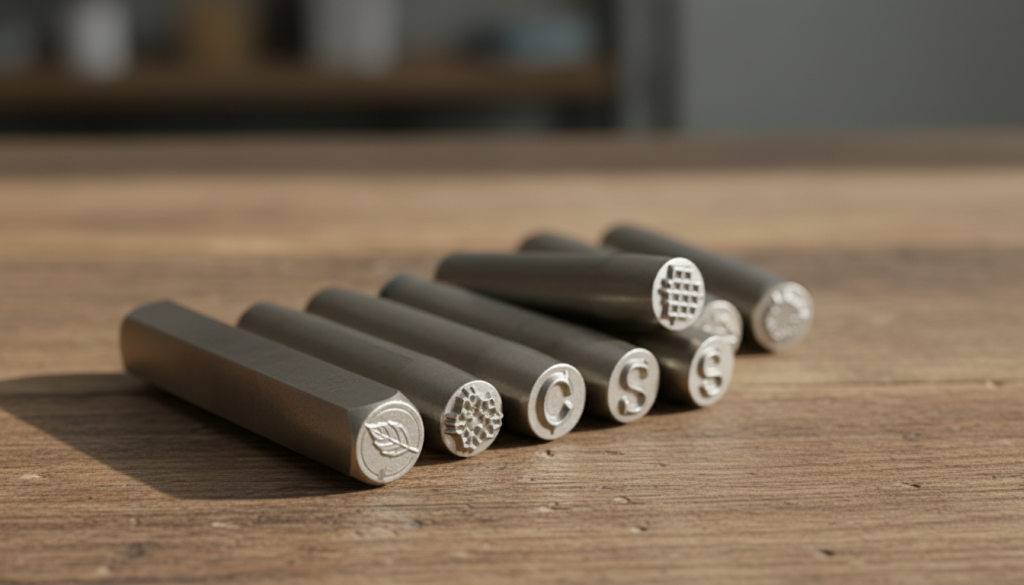
Ordering custom steel stamps should be straightforward—you need a tool that creates permanent, legible marks on your parts. But in our 60+ years at Devore Engraving, we’ve seen manufacturers make the same costly mistakes repeatedly. These errors don’t just waste money on the initial purchase; they lead to poor mark quality, premature tool failure, and production delays that compound over time.
According to the National Institute of Standards and Technology (NIST), proper part identification and traceability systems are fundamental to quality manufacturing. Their Manufacturing Extension Partnership program emphasizes that permanent marking is a critical component of modern production systems. Yet many manufacturers rush into stamp purchases without adequate planning.
The good news? Every one of these mistakes is preventable with proper planning and the right guidance from an experienced stamp manufacturer. This article walks through the five most common errors we encounter and provides practical solutions to help you get the marking tools you need the first time.
Mistake #1: Providing Incomplete or Unclear Design Specifications
The most frequent problem we see is customers who haven’t fully thought through what their stamp needs to accomplish. They might provide a rough sketch or simply say “we need our logo stamped on these parts” without considering critical details.
Why This Matters
When design specifications are vague, stamp manufacturers must make assumptions about:
- Character height and depth
- Line thickness and spacing
- Border placement and margins
- Mark orientation relative to part features
If these assumptions don’t match your actual requirements, you’ll receive a stamp that technically matches what you requested but doesn’t work for your application. The result is either accepting substandard marks or paying for a completely new stamp.
How to Avoid This Mistake
Before contacting a stamp manufacturer, document these details:
- Exact text or graphics needed, including all punctuation and special characters
- Character dimensions (height in inches or millimeters)
- Mark depth requirements based on your material and application
- Available marking area on your parts
- Legibility distance (will operators read marks from 2 feet away or 20 feet?)
- Critical features that must be included (company name, part numbers, date codes, compliance symbols)
For custom logo stamps, provide vector files (AI, EPS, or PDF format) rather than low-resolution images. Vector files ensure your logo reproduces accurately at any size without pixelation.
When marking serial numbers or part numbers, consider whether you need a fixed stamp or a system that allows digit changes for sequential numbering.
Real-World Example
An automotive supplier once ordered stamps with 3/16″ characters for marking engine components. When they received the stamps and tested them, they discovered the marks were too small to be easily read by inspectors wearing safety glasses. They needed 1/4″ characters minimum. Because they hadn’t tested legibility requirements before ordering, they had to purchase new stamps and absorb the cost of the incorrect ones.
Mistake #2: Choosing the Wrong Steel Grade or Heat Treatment
Not all steel stamps are created equal. The material grade and heat treatment determine how long your stamp will last and what materials it can effectively mark. Yet many customers don’t realize they have options or don’t understand which choice suits their application.
Why This Matters
A stamp made from improper steel or inadequately heat-treated will:
- Wear prematurely, requiring frequent replacement
- Deform under impact, creating distorted marks
- Chip or crack when marking hard materials
- Fail catastrophically during production, causing downtime
Steel stamp life expectancy depends heavily on material selection. A stamp meant for occasional use on aluminum requires different specifications than one designed to mark hardened steel thousands of times per day.
How to Avoid This Mistake
Work with your stamp manufacturer to specify:
- Material being marked (mild steel, stainless steel, aluminum, plastic, wood, leather, etc.)
- Material hardness (Rockwell scale if known)
- Expected usage volume (occasional use vs. high-volume production)
- Impact method (hand hammer, drop hammer, arbor press, pneumatic system)
- Environment (temperature extremes, chemical exposure, outdoor use)
For most industrial applications, tool steel grades like O1, A2, or D2 properly heat-treated to 58-62 Rockwell C hardness provide the best balance of durability and toughness. Custom hand stamps for lighter-duty applications may use different grades optimized for clarity rather than extreme durability.
Special Considerations for Different Industries
Different industries have specific requirements:
- Automotive marking often involves hardened steel components requiring premium tool steel stamps
- Medical device manufacturing may need stamps that won’t contaminate sterile environments
- Food and beverage applications might require corrosion-resistant materials
- Railroad components demand stamps capable of withstanding outdoor conditions
Mistake #3: Ignoring the Marking Surface Characteristics
Many customers focus entirely on the stamp design without considering the surface they’ll be marking. The reality is that surface conditions dramatically affect mark quality and stamp longevity.
Why This Matters
Attempting to mark inappropriate surfaces leads to:
- Incomplete or illegible impressions
- Excessive stamp wear
- Surface damage that compromises part integrity
- Inconsistent mark quality across production runs
How to Avoid This Mistake
Evaluate these surface characteristics before ordering stamps:
Surface Hardness
Harder surfaces require more impact force and harder stamps. If marking hardened steel, specify this to your stamp manufacturer so they can recommend appropriate materials and dimensions.
Surface Finish
- Rough, as-cast surfaces may not show fine details clearly
- Highly polished surfaces can make marks difficult to see without proper lighting
- Textured surfaces may require deeper marks for adequate contrast
Surface Curvature
Flat stamps don’t work well on curved surfaces. For marking pipes, rods, or cylindrical parts, consider roll dies specifically designed for curved geometries.
Coating or Plating
If parts are painted, powder-coated, or plated after marking, the marks must be deep enough to remain visible through the coating. Conversely, if marking painted surfaces, the stamp must cut through the coating to reach the base material.
Real-World Example
A construction equipment manufacturer ordered standard flat stamps for marking part numbers on large diameter steel shafts. The stamps created distorted, partially-formed characters on the curved surface. They needed concave stamps or roll dies matched to the shaft diameter. This seemingly simple oversight delayed production by three weeks while corrected tooling was manufactured.
Mistake #4: Overlooking Regulatory and Compliance Requirements
Many industries have specific regulations governing part marking, identification, and traceability. Failing to account for these requirements when designing stamps can result in non-compliant marks that must be corrected—often requiring complete part rework or scrapping.
Why This Matters
Non-compliant marking can lead to:
- Failed quality audits
- Regulatory penalties and fines
- Inability to ship products
- Complete batch rejection
- Loss of customer contracts
- Expensive recall management
How to Avoid This Mistake
Research applicable standards before finalizing stamp designs:
Industry-Specific Standards
- Aerospace (AS9100) has strict requirements for permanent identification
- Automotive (IATF 16949) mandates specific traceability marking
- Medical devices (ISO 13485, FDA 21 CFR Part 820) require UDI (Unique Device Identification) compliance
- Food packaging (FDA, USDA) has specific lot coding requirements
Information Content Requirements
Regulations often specify what information must be included:
- Manufacturing date or lot code
- Supplier identification
- Material grade or specification
- Country of origin
- Compliance symbols (CE, UL, etc.)
- Serial numbers for traceability
Character Size and Legibility
Some regulations specify minimum character heights, mark contrast, or permanence requirements. Your stamps must be designed to meet these specifications.
Work with Experienced Manufacturers
At Devore Engraving, we’ve helped manufacturers in regulated industries design compliant marking systems for decades. Our team understands the specific requirements for automotive, railroad, medical, and food processing applications.
Mistake #5: Failing to Plan for Marking Method and Tooling Integration
A beautifully designed stamp is worthless if you can’t apply it effectively to your parts. Many customers order stamps without considering how they’ll actually be used in production.
Why This Matters
Without proper planning for marking method and integration:
- Operators may struggle to position stamps correctly
- Marks may be inconsistent or misaligned
- Production throughput suffers from slow marking processes
- Ergonomic issues lead to operator fatigue and errors
- Traceability systems become unreliable
How to Avoid This Mistake
Consider these factors before ordering:
Marking Method
Will you use:
- Hand hammer and hand-held stamps
- Arbor press with fixtures
- Drop hammer or impact press
- Pneumatic or hydraulic marking system
- Roll marking equipment
Each method requires different stamp designs, shank dimensions, and mounting specifications.
Part Fixturing
Large or irregularly-shaped parts need fixtures to hold them in position during marking. Consider how parts will be secured and oriented. If you’re marking hundreds of parts per day, investing in proper fixtures dramatically improves consistency and speed.
Operator Access
Can operators comfortably reach the marking location? For marks on interior surfaces or hard-to-reach areas, you may need specialized stamp designs with extended shanks or angled faces.
Production Volume and Speed
Low-volume marking (dozens per week) works fine with manual hand stamps. High-volume production (thousands per day) may justify automated marking systems with machine stamps integrated into production lines.
Quality Verification
How will you verify mark quality? Some applications require vision systems or inspection stations to ensure legibility. Your marking method should produce consistent depths and clarity that meet your inspection criteria.
Additional Considerations for Successful Stamp Ordering
Beyond the five major mistakes above, keep these factors in mind:
Sample Parts
If possible, send sample parts to your stamp manufacturer. Physical samples eliminate ambiguity about size, material, and surface conditions. Manufacturers can create test impressions on your actual parts before finalizing the stamp design.
Prototyping
For complex or critical applications, consider ordering a prototype stamp for testing before committing to production quantities. The cost of a prototype is negligible compared to producing dozens of stamps that don’t work correctly.
Communication
Maintain open communication with your stamp manufacturer throughout the process. Share photos, drawings, and detailed descriptions. Ask questions about capabilities, limitations, and recommendations. Experienced manufacturers like Devore Engraving can suggest design improvements you might not have considered.
Lead Time Planning
Custom stamps typically require 2-4 weeks for design, manufacture, and heat treatment. Plan your orders accordingly to avoid rush fees or production delays. For ongoing needs, maintaining a small inventory of commonly-used stamps provides buffer against unexpected demand.
Documentation
Keep records of your stamp specifications, including drawings, material certifications, and heat treatment records. This documentation becomes invaluable when reordering stamps or troubleshooting marking quality issues.
The Cost of Getting It Wrong vs. The Value of Getting It Right
Consider the total cost of ordering incorrect stamps:
Direct Costs
- Replacement stamps (often expedited)
- Disposal of unusable stamps
- Engineering time to redesign
Indirect Costs
- Production delays while waiting for correct stamps
- Rework to correct non-compliant marks
- Potential customer chargebacks for late deliveries
- Damage to customer relationships
- Missed market opportunities
These costs typically exceed the stamp purchase price by 10-100 times.
Conversely, investing time in proper specification and working with an experienced manufacturer like Devore Engraving delivers:
- Stamps that work correctly the first time
- Consistent mark quality throughout stamp life
- Reduced training time for operators
- Confidence in compliance and traceability
- Lower total cost of ownership
How Devore Engraving Helps You Avoid These Mistakes
Since 1963, we’ve guided thousands of customers through the stamp ordering process. Our approach includes:
Expert Consultation
Our team asks the right questions to understand your application, not just take an order. We review material specifications, production volumes, and marking requirements to recommend optimal solutions.
Engineering Support
We provide technical guidance on stamp design, material selection, and marking methods. If your initial specifications won’t work, we’ll explain why and suggest proven alternatives.
Design Validation
Before manufacturing begins, we review detailed drawings with customers to ensure all specifications are correct. This prevents expensive mistakes and delays.
Quality Manufacturing
Our CNC engraving capabilities, precision machining, and specialized heat treating deliver custom steel stamps built to demanding specifications. Every stamp undergoes inspection before shipping.
Ongoing Support
After delivery, we remain available for questions about stamp use, maintenance, and reordering. Many of our customers have worked with us for decades because they know we’ll support them throughout the stamp’s lifetime.
Ready to Order Custom Stamps the Right Way?
Avoiding these five critical mistakes requires thoughtful planning and expert guidance. Don’t rely on guesswork or incomplete specifications when ordering marking tools that affect your production quality and efficiency.
Whether you need custom hand stamps for low-volume marking, embossing dies for branding, or complete marking systems for automated production, Devore Engraving has the experience and capabilities to deliver tools that work correctly the first time.
Request a quote today and let our team help you specify stamps that meet your exact requirements. With proper planning and expert manufacturing, you’ll receive marking tools that deliver consistent, compliant results for years to come.