
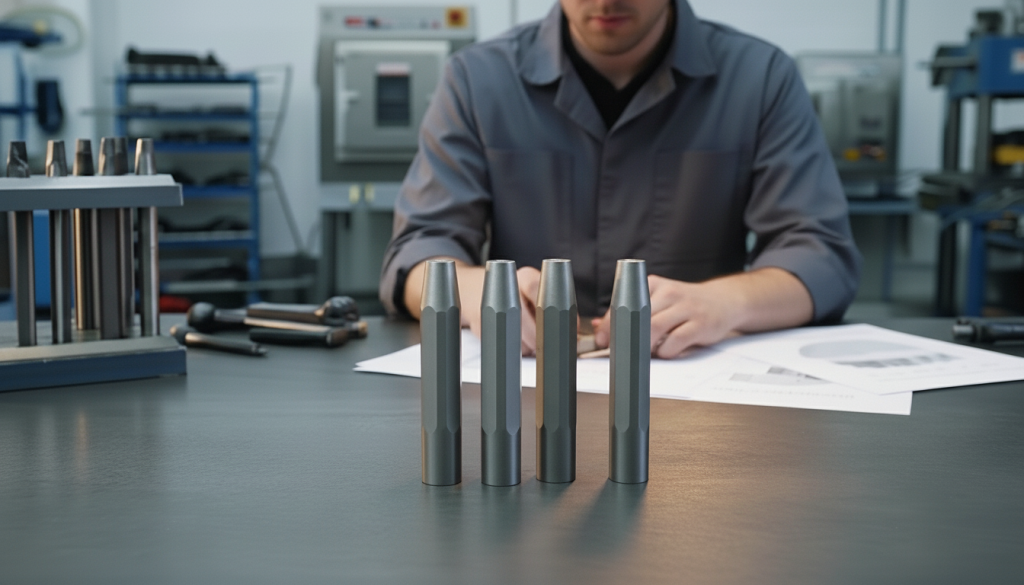
When ordering custom steel stamps, one of the most critical—yet often overlooked—decisions is material selection. The steel grade used to manufacture your stamps directly determines how long they’ll last, what materials they can mark effectively, and how they’ll perform under your specific operating conditions.
Many customers simply accept whatever “standard” material their supplier offers without understanding that steel selection should match application requirements. This oversight can result in stamps that wear prematurely, fail catastrophically, or simply never deliver the performance expected.
The ASM International (formerly American Society for Metals) maintains comprehensive databases on material properties and applications. Their research on tool steel selection and heat treatment provides the technical foundation for matching materials to demanding applications like permanent part marking.
At Devore Engraving, material selection is one of the first conversations we have with customers. After 60+ years manufacturing stamps for diverse applications, we’ve learned that the right steel grade, properly heat treated, makes the difference between stamps that last months and stamps that last decades.
This guide explains the steel grades commonly used for stamps, their properties, and how to select materials that optimize performance for your specific marking requirements.
Understanding Steel Grade Classifications
Tool steels—the category used for most industrial stamps—are classified by composition and intended use. The American Iron and Steel Institute (AISI) designation system groups steels by their primary alloying elements.
Common Tool Steel Categories
O-Series (Oil-Hardening Steels)
- Examples: O1, O2, O6
- Characteristics: General purpose, good toughness, moderate wear resistance
- Hardening: Oil quench
- Typical hardness: 58-62 Rockwell C
A-Series (Air-Hardening Steels)
- Examples: A2, A6, A8
- Characteristics: Better dimensional stability, good wear resistance
- Hardening: Air quench (less distortion than oil quench)
- Typical hardness: 58-62 Rockwell C
D-Series (High-Carbon, High-Chromium Steels)
- Examples: D2, D3, D7
- Characteristics: Excellent wear resistance, lower toughness
- Hardening: Air quench
- Typical hardness: 58-62 Rockwell C
S-Series (Shock-Resistant Steels)
- Examples: S1, S5, S7
- Characteristics: Maximum toughness, moderate wear resistance
- Hardening: Various methods
- Typical hardness: 50-58 Rockwell C
M-Series and T-Series (High-Speed Steels)
- Examples: M2, M4, T15
- Characteristics: Extreme hardness and wear resistance
- Hardening: Complex heat treatment
- Typical hardness: 62-65+ Rockwell C
Each category offers different trade-offs between hardness, toughness, wear resistance, and cost. Understanding these trade-offs helps match material to application.
Key Material Properties for Stamp Performance
When selecting stamp materials, several properties matter:
Hardness
Measures resistance to deformation and wear. Harder stamps mark harder materials and last longer, but excessive hardness increases brittleness.
Toughness
Measures resistance to fracture and impact damage. Tougher materials withstand mis-strikes and abuse better but may wear faster.
Wear Resistance
Measures how well material resists abrasion. High wear resistance extends stamp life in high-volume applications but often comes with reduced toughness.
Machinability
Affects manufacturing cost and complexity. Some materials are difficult to machine precisely, increasing stamp production costs. Materials with excellent machinability also make it easier to reproduce fine engraved detail — a key consideration if your application involves logos or custom graphics rather than simple text or numbers.
Heat Treatment Response
Determines how consistently materials achieve target properties. Stable heat treatment response ensures predictable performance.
The ideal stamp material balances these properties for your specific application. There’s no universal “best” steel—only the best steel for your requirements.
O1 Tool Steel: The General Purpose Standard
O1 is the most commonly specified tool steel for custom hand stamps and general industrial marking applications.
Composition
- Carbon: 0.90%
- Manganese: 1.20%
- Chromium: 0.50%
- Tungsten: 0.50%
Properties
- Excellent machinability allows fine detail engraving
- Good toughness handles hand stamping applications well
- Moderate wear resistance suitable for low to medium production volumes
- Straightforward heat treatment with predictable results
Best Applications
- Hand stamps for manual marking
- Low to medium volume production (hundreds to thousands of impressions)
- Marking soft to medium-hardness materials (aluminum through mild steel)
- Applications where fine detail matters more than extreme durability
Limitations
- Moderate wear resistance limits life in high-volume applications
- Not ideal for marking hardened steels or extremely abrasive materials
- Requires oil quenching which can cause slight distortion on complex geometries
When to Choose O1
O1 represents excellent value for most manual marking applications. If you’re marking fewer than 10,000 parts annually with hand stamps, O1 likely provides optimal performance at reasonable cost. For a broader comparison of when manual marking makes more sense than automated marking, see our guide on machine stamps vs. hand stamps.
A2 Tool Steel: Dimensional Stability and Wear Resistance
A2 offers improved performance over O1 with better wear resistance and excellent dimensional stability during heat treatment.
Composition
- Carbon: 1.00%
- Chromium: 5.00%
- Molybdenum: 1.00%
- Vanadium: 0.20%
Properties
- Superior wear resistance extends stamp life
- Air hardening minimizes distortion during heat treatment
- Good toughness balances with wear resistance
- Maintains sharp edges longer than O1
Best Applications
- Machine stamps for automated production
- Medium to high volume marking (thousands to hundreds of thousands of impressions)
- Applications requiring excellent dimensional accuracy
- Marking medium-hardness materials consistently
Limitations
- Slightly more expensive than O1
- Good but not exceptional resistance to very hard materials
- Moderate machinability affects production cost slightly
When to Choose A2
A2 is ideal for machine stamp applications where dimensional stability matters and production volumes justify the incremental cost. Many automotive marking applications use A2 for its reliable performance.
D2 Tool Steel: Maximum Wear Resistance
D2 provides exceptional wear resistance for the most demanding applications. Its high chromium content creates abundant hard carbides throughout the structure.
Composition
- Carbon: 1.50%
- Chromium: 12.00%
- Molybdenum: 0.80%
- Vanadium: 0.80%
Properties
- Excellent wear resistance—among the best air-hardening steels
- Good dimensional stability during heat treatment
- Moderate toughness (lower than O1 or A2)
- Retains hardness at moderately elevated temperatures
Best Applications
- High-volume production marking (hundreds of thousands to millions of impressions)
- Marking harder materials (heat-treated steels, stainless steels)
- Abrasive environments where rapid wear is a concern
- Critical traceability applications where stamp replacement would disrupt production
Limitations
- Lower toughness increases risk of chipping if misused
- More expensive than O1 or A2
- Requires careful heat treatment for optimal properties
- More difficult to machine, increasing manufacturing cost
When to Choose D2
D2 makes sense for high-volume operations where extended stamp life justifies the higher initial cost. Railroad and heavy equipment marking often uses D2 for durability in harsh conditions.
S7 Tool Steel: Shock Resistance for Impact Applications
S7 prioritizes toughness over wear resistance, making it ideal for applications where stamps experience severe impact or abuse.
Composition
- Carbon: 0.50%
- Chromium: 3.25%
- Molybdenum: 1.40%
- Vanadium: 0.20%
Properties
- Exceptional toughness and impact resistance
- Good fatigue resistance under repeated loading
- Moderate hardness (typically 52-58 HRC) balances toughness with performance
- Excellent resistance to chipping and cracking
Best Applications
- Heavy impact marking with powerful pneumatic or hydraulic systems
- Marking extremely hard materials where chipping is a concern
- Applications where stamps experience off-angle strikes or abuse
- Environments where stamp breakage could cause safety issues
Limitations
- Lower wear resistance than A2 or D2
- Moderate hardness limits performance on very hard materials
- Higher cost than general-purpose grades
When to Choose S7
S7 is the right choice when stamp survival is more critical than maximum wear life. Large custom machine parts marking with powerful automated systems often benefits from S7’s toughness.
High-Speed Steels (M2, M4): Extreme Applications
High-speed steels offer maximum hardness and wear resistance but at significant cost and complexity.
Composition (M2 example)
- Carbon: 0.85%
- Chromium: 4.00%
- Molybdenum: 5.00%
- Tungsten: 6.00%
- Vanadium: 2.00%
Properties
- Exceptional hardness (62-65 HRC)
- Superior wear resistance
- Retains hardness at elevated temperatures
- Complex carbide structure provides extreme abrasion resistance
Best Applications
- Marking extremely hard materials (hardened tool steel, ceramics)
- Ultra-high volume production where maximizing stamp life is critical
- Specialized applications where no other material performs adequately
Limitations
- Significantly more expensive than conventional tool steels
- Complex heat treatment requires specialized expertise
- Lower toughness than conventional grades
- Difficult to machine, increasing manufacturing costs substantially
When to Choose High-Speed Steel
HSS grades make sense only for the most demanding applications where conventional tool steels don’t provide adequate life. Most customers never need these premium materials.
Matching Steel Grade to Material Being Marked
The hardness relationship between stamp and workpiece critically affects performance.
General Rule
Stamps should be 5-10 Rockwell C points harder than the material being marked. This differential ensures stamps can indent the workpiece without excessive wear.
Marking Soft Materials (Aluminum, Brass, Copper)
- Workpiece hardness: 20-60 HRB (Rockwell B)
- Stamp material: O1, A2 (58-62 HRC) provides more than adequate hardness
- Consideration: Toughness matters more than extreme hardness
Marking Medium Materials (Mild Steel, Low-Carbon Steel)
- Workpiece hardness: 60-90 HRB or 10-25 HRC
- Stamp material: O1 for low volume, A2 for higher volume (58-62 HRC)
- Consideration: Balance wear resistance with cost
Marking Hard Materials (Heat-Treated Steel, Tool Steel)
- Workpiece hardness: 30-50 HRC
- Stamp material: A2 or D2 (58-62 HRC), possibly S7 if toughness is critical
- Consideration: Stamp hardness should exceed workpiece by at least 10 points
Marking Very Hard Materials (Hardened Tool Steel, Die Steel)
- Workpiece hardness: 50-62 HRC
- Stamp material: D2 or high-speed steel (62-65+ HRC)
- Consideration: Only stamps harder than workpiece will survive
For medical device applications marking various alloys, careful material selection ensures stamps handle the range of materials encountered.
Heat Treatment: As Important as Material Selection
Steel grade alone doesn’t determine performance—proper heat treatment is equally critical.
Heat Treatment Goals
- Achieve target hardness throughout stamp
- Maximize toughness at that hardness
- Minimize distortion during processing
- Ensure consistent properties part-to-part
Critical Heat Treatment Steps
Stress Relieving
Pre-heating removes residual stresses from machining, reducing risk of distortion or cracking during hardening.
Austenitizing
Heating to critical temperature (varies by steel grade) transforms steel structure to prepare for hardening.
Quenching
Rapid cooling “freezes” the transformed structure, creating hardness. Quench medium (oil, air, salt bath) depends on steel grade.
Tempering
Controlled reheating reduces brittleness while maintaining most of the hardness. Multiple temper cycles optimize properties.
Cryogenic Treatment (optional)
Some high-performance applications benefit from sub-zero treatment that completes transformation and increases wear resistance.
At Devore Engraving, we maintain in-house heat treatment capabilities with precise temperature control and documented procedures. This ensures every stamp achieves optimal properties for its intended application.
Cost Considerations in Material Selection
Material costs vary significantly between grades:
Relative Material Costs (O1 = baseline 1.0)
- O1: 1.0x
- A2: 1.3-1.5x
- D2: 1.8-2.2x
- S7: 2.0-2.5x
- High-Speed Steel: 3.0-5.0x
However, material cost is just one component of total stamp cost. Manufacturing complexity, heat treatment requirements, and expected service life all factor into value analysis.
Total Cost of Ownership Analysis
Consider a machine stamp for high-volume production:
Scenario: 500,000 parts marked over 5 years
Option A: O1 stamp at $150
- Expected life: 100,000 impressions
- Stamps needed: 5
- Total cost: $750
- Plus downtime for 4 stamp changes
Option B: D2 stamp at $250
- Expected life: 500,000+ impressions
- Stamps needed: 1
- Total cost: $250
- No production interruptions
The premium material costs less overall while delivering better reliability. For high-volume operations, material selection dramatically affects total cost.
Special Material Considerations
Some applications require unusual material choices.
Corrosion Resistance
Standard tool steels rust in humid or corrosive environments. Options include:
- Stainless tool steels (440C, CPM steels)
- Protective coatings (chrome plating, nitriding)
- Environmental controls (dehumidification, protective storage)
Food processing and canning equipment marking may require corrosion-resistant materials.
Non-Magnetic Requirements
Some precision applications can’t tolerate magnetic materials. Non-magnetic tool steels or specialty alloys address these requirements.
Temperature Extremes
Stamps used in hot environments (near furnaces, in hot-forming operations) need materials that maintain properties at elevated temperatures. High-speed steels or specialty high-temperature alloys may be necessary.
Material Verification and Quality Assurance
How do you know stamps are actually made from specified materials with proper heat treatment?
Material Certifications
Reputable manufacturers provide material certifications tracing steel to specific heats with documented chemistry.
Hardness Testing
Stamps should be hardness tested after heat treatment. Rockwell testing verifies proper hardening. At Devore Engraving, we test every batch and can provide hardness reports with orders.
Dimensional Inspection
Properly heat-treated stamps maintain dimensional accuracy. Excessive distortion indicates heat treatment problems.
Performance Testing
Ultimate verification comes from performance in actual use. Test stamps on your materials under real conditions before committing to large orders.
Custom Material Selection: Working with Devore Engraving
Our material selection process ensures optimal performance:
Application Analysis
We discuss your marking requirements in detail:
- What materials are you marking?
- What production volumes do you expect?
- What environmental conditions will stamps experience?
- What performance priorities matter most (life expectancy, cost, precision)?
Recommendation
Based on our experience with similar applications, we recommend specific grades with rationale explaining why they’re appropriate.
Sample Testing (when appropriate)
For critical applications or when material selection is unclear, we can manufacture sample stamps in different grades for comparative testing.
Documentation
We provide complete documentation including material certifications, heat treatment records, and hardness test results.
Ongoing Support
After delivery, we monitor performance and adjust recommendations if unexpected wear or issues develop.
Common Material Selection Mistakes
Material selection is just one piece of a larger set of pitfalls buyers run into. We cover the full picture, including specification errors, unrealistic lead times, and communication gaps, in our guide to 5 critical mistakes to avoid when ordering custom steel stamps. The material-specific mistakes are below.
Mistake 1: Choosing Based Only on Cost
Selecting the cheapest material often costs more long-term through premature failure and frequent replacement.
Solution: Evaluate total cost of ownership including expected service life and replacement frequency.
Mistake 2: Over-Specifying Material
Some customers specify premium materials for applications where general-purpose grades would perform adequately.
Solution: Match material to actual requirements. Save premium materials for applications that truly need them.
Mistake 3: Ignoring Heat Treatment
Even premium materials perform poorly without proper heat treatment.
Solution: Work with manufacturers who control heat treatment and can document proper processing.
Mistake 4: Not Considering Application Environment
Standard materials may not survive corrosive, high-temperature, or other extreme environments.
Solution: Discuss complete operating conditions with your stamp manufacturer, not just basic marking requirements.
Conclusion: Right Material Means Right Performance
Steel grade selection directly determines whether your stamps deliver years of reliable service or fail prematurely. While the technical details can seem complex, the decision process is straightforward when working with experienced manufacturers who understand real-world applications.
At Devore Engraving, we’ve manufactured stamps from every common tool steel grade and many specialty materials. This experience—combined with our in-house heat treatment capabilities—ensures stamps that optimize performance for your specific requirements.
Whether you need hand stamps for field service work, machine stamps for automated production lines, or specialized marking tools for unique applications, proper material selection maximizes value and minimizes total cost of ownership.
Ready to discuss material selection for your marking application? Contact our engineering team today. We’ll help you specify the right steel grade and heat treatment to deliver optimal performance, whether you’re marking automotive parts, railroad components, medical devices, or any other application requiring permanent, reliable identification.
Request a quote today and let us apply 60+ years of experience to your marking challenges.
