
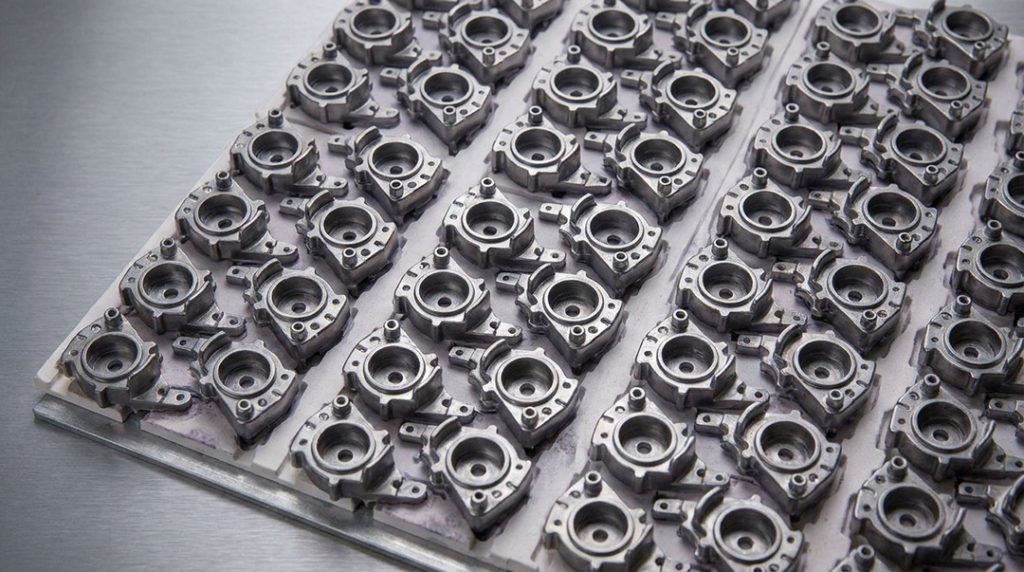
Injection mold inserts require permanent identification for the same reasons that manufactured parts do — and then some. A mold insert must be traceable to its design revision, material specification, and manufacturing record throughout a service life that can span millions of cycles and decades of production. It must carry cavity identification that transfers to every part the mold produces. And in regulated industries, the cavity number embedded in the finished part connects the end product back to the specific insert that produced it — a traceability link that supports recall response and quality investigation.
Steel stamps serve mold making in two related but distinct ways: marking the insert body itself for identification and traceability, and engraving markings into the insert that transfer to the molded part as a raised or recessed feature. Both applications share the same tooling fundamentals but serve different purposes and require different specifications.
Insert Body Identification Marking
Marking the body of a mold insert — on a non-functional surface that doesn’t contact the molded part — serves the same traceability purpose as marking any other precision tooling. Insert number, revision level, material designation, heat treat lot, and shop order number applied to the back face or outside diameter of an insert enable maintenance technicians, mold setters, and quality personnel to identify and track the insert throughout its service life.
Insert body marking occurs on hardened steel — typically H13, P20, or S7 tool steels depending on the molding application. These materials are harder than common structural steels and require stamps specifically hardened for the substrate. Stamp material selection for mold insert marking must account for the insert steel hardness to ensure adequate impression depth without stamp failure.
The marking location on the insert body must be on a non-functional surface — any marking that contacts the mold parting line, the molded part surface, or any sealing or clamping surface will either damage the mold function or transfer the mark to the molded part unintentionally. Clear communication between the mold design team and the marking operation about acceptable marking locations prevents this problem.
Cavity Marking That Transfers to the Molded Part
Many injection molded parts carry a cavity number — a single digit or short alphanumeric code that identifies which cavity in a multi-cavity mold produced each part. This identification enables traceability to the specific insert when dimensional or cosmetic variation occurs, enabling targeted corrective action rather than pulling the entire mold from production.
Cavity numbers are incorporated into mold inserts either by engraving into the insert cavity surface — which produces a raised feature on the molded part — or by adding a raised feature to the insert — which produces a recessed mark on the molded part. Which approach is correct depends on the part drawing specification and the molded part’s intended appearance. Raised marks on the part may be specified for visibility; recessed marks are common where the mark must not project above the part surface.
The accuracy and detail quality of cavity marks in mold inserts directly affects every part produced over the insert’s production life. A cavity number engraved into an insert with poor definition produces parts with barely legible cavity numbers from the first shot and impossible-to-read numbers as the insert wears. Investing in quality engraving for cavity identification marks pays dividends across the entire production run.
Date Code Inserts and Interchangeable Marking Features
Many regulated applications require date codes on molded parts — the year of manufacture, quarter, or specific date code format embedded in each part to support shelf life management and recall traceability. For production runs spanning multiple years, this requires date code elements in the mold that can be updated without replacing the entire insert.
Date code inserts — small removable blocks that carry the date marking and can be swapped out as the date changes — solve this problem. The main insert body remains in service while only the date insert changes. This approach is used widely in automotive, medical device, and consumer products molding where part date codes are required and production runs span multiple years.
The design of date code insert pockets requires precision — the insert must seat repeatably in the same position on every installation, with no parting line, step, or gap that would create a visible artifact on the molded part surface. Devore Engraving produces date code inserts and other small marking features for mold applications to the dimensional tolerances that mold design requires.
Mold Insert Marking for Regulatory Compliance
In medical device molding, FDA UDI requirements and ISO 13485 quality management standards drive specific part marking requirements that the mold must produce. The traceability requirements in medical device manufacturing extend from the finished device back through the production process — and for molded components, that traceability includes the specific cavity and production date encoded in each part.
Automotive applications require cavity identification and date codes on many plastic components to support supplier quality requirements and recall traceability. IATF 16949 quality management requirements flow through the supply chain to component manufacturers, including traceability requirements that depend on reliable part marking.
In both contexts, the quality of the marking feature in the mold determines the quality of the identification on every part produced. A poorly engraved cavity number that is legible on new inserts but illegible after 100,000 shots provides no traceability for the majority of the insert’s production life.
Working with Mold Makers on Marking Specifications
Effective mold insert marking requires coordination between the mold design team, the mold manufacturer, and the stamp or engraving supplier. The mold design defines where marking features are located, what they contain, and what dimensions they must meet. The mold manufacturer incorporates those features into the insert. The engraving supplier produces the tools or performs the engraving that creates those features.
Early involvement of the engraving supplier in the design process catches problems before tooling is committed. Character sizes that are too small for the insert steel hardness, marking locations that create parting line issues, and date code pocket designs that won’t hold dimensional tolerances are all easier to resolve on the drawing than in production.
Where Insert Body Marking Overlaps With Machine Stamps
Insert body identification, as opposed to the cavity feature itself, is often applied with the same tooling used on other hardened production components. Devore’s custom metal machine stamps are built for exactly this kind of repeatable marking on hardened tool steel, where consistent depth and alignment matter across a full set of inserts.
Mold Insert Marking Solutions from Devore Engraving
Devore Engraving has served mold makers with custom steel stamps, die engraving, and precision marking solutions since 1963. Our capabilities include insert body identification marking, cavity number engraving, date code insert production, and custom marking features for injection mold applications across automotive, medical device, consumer products, and industrial markets.
Request a quote with your insert material, marking location, required mark content, and any dimensional requirements for date code inserts or interchangeable marking features. We will work with your mold design requirements to specify the right solution.
