
Picking the wrong marking method means redoing the work, or worse, damaging a finished piece. Hand stamping, wood burning, and laser engraving all produce a permanent mark, but they work in completely different ways and aren’t interchangeable across materials. This guide compares all three so you can choose the right one for what you’re actually marking. If you’re specifically weighing whether a custom metal hand stamp can handle your material, our materials guide for metal, wood, and plastic covers that in more depth.
Each method has a place. The right choice depends on your material, how permanent and durable the mark needs to be, your budget, and how much volume you’re producing.
How Each Method Actually Works
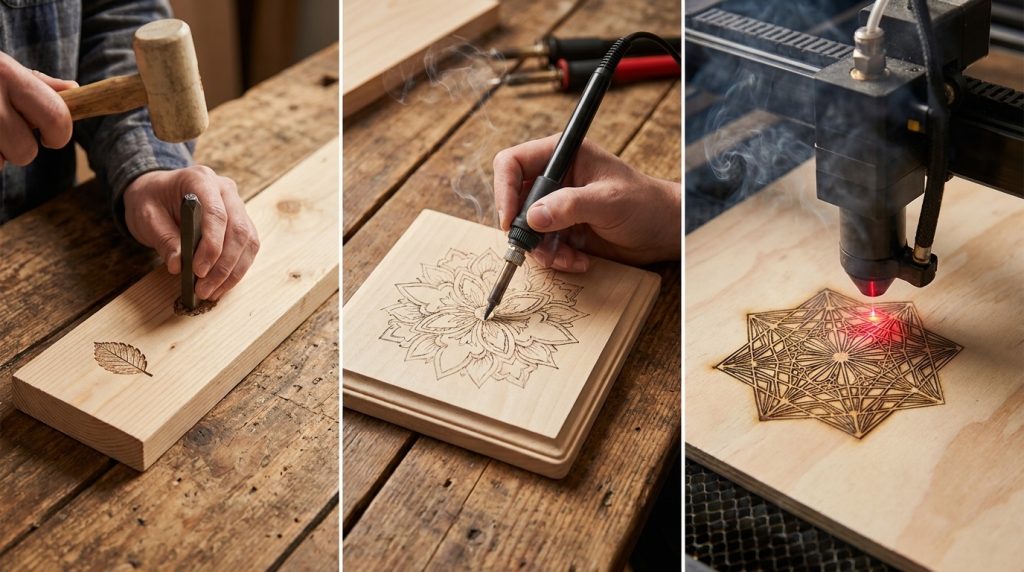
Hand stamping uses a hardened steel tool with a raised or recessed character face. A strike, by hammer or arbor press, drives the stamp into the material and physically displaces it, leaving a permanent recessed or raised impression. No heat, no light, no consumables.
Wood burning (pyrography) uses a heated tip to char the surface of wood, creating a dark, visible mark through controlled burning rather than displacement. It requires a power source and steady hand control, or a heated branding iron for repeatable marks.
Laser engraving uses a focused beam of light to vaporize or discolor the surface material. It’s computer-controlled, which makes it precise and repeatable, but it requires laser equipment and, depending on the material, ventilation for fumes.
Durability Comparison
Durability is where the three methods separate the most.
A hand-stamped mark is a physical impression in the material itself. It doesn’t fade, peel, wear off, or lighten with age, and it survives handling, weather, and abrasion better than a surface-level mark. This is why hand stamps are the standard for permanent part identification in industrial and outdoor applications.
A wood-burned mark is also permanent in the sense that it’s charred into the wood, but it exists only at the surface. Heavy sanding, weathering, or repeated handling can visibly fade or soften a burned mark over years of use.
A laser-engraved mark is durable and precise, but like wood burning, it’s a surface-level effect. On some materials it can fade under UV exposure or heavy surface wear, though it holds up well under normal handling.
For anything that needs to survive decades of outdoor exposure, repeated handling, or industrial use, hand stamping is the most durable of the three.
Material-by-Material Fit
Metal
Hand stamping is really the only practical option of the three for metal. Wood burning obviously doesn’t apply, and laser engraving on metal requires specialized fiber or metal-rated laser equipment that’s a significant investment beyond what most small shops or individuals have access to. A hand stamp remains the most accessible and durable way to mark metal without industrial equipment.
Wood
All three methods work on wood, and the right choice comes down to what you’re going for.
Hand stamping gives you a crisp, depth-based impression that holds up to years of handling, ideal for tool handles, crates, or furniture that will see real use. Wood burning produces a warm, visibly charred mark that many people associate with handcrafted or rustic branding, well-suited to decorative work and gift items. Laser engraving offers the most precision for fine detail, logos, or photographic-style images, but requires laser equipment most hobbyists don’t own.
Plastic
Laser engraving and hand stamping both work on plastic, depending on the type. Wood burning is generally not suitable for plastic, since many plastics melt unevenly, release harmful fumes when heated, or simply don’t char the way wood does.
Hand stamping works well on rigid plastics with enough thickness to absorb the impression. Laser engraving tends to produce cleaner, more precise results on thinner or more detailed plastic parts, since there’s no physical force involved. For plastic parts specifically, our materials guide covers which types hold up best to hand stamping.
Cost and Equipment Comparison
Hand stamping requires the lowest upfront investment of the three. A custom hand stamp and a hammer or arbor press are all you need, no power source, no specialized ventilation, and the stamp itself lasts for years with basic care.
Wood burning requires a burning tool or branding iron, which ranges from inexpensive hobbyist pens to more expensive temperature-controlled units for repeatable commercial work.
Laser engraving has by far the highest upfront cost. Laser engravers, especially ones capable of marking metal, represent a substantial equipment investment, plus ongoing costs for maintenance, ventilation, and in some cases per-unit software or licensing.
Speed and Volume
For one-off pieces or small batches, hand stamping and wood burning are both fast and don’t require any setup time beyond positioning the tool. Laser engraving requires digital file setup for each design but can then run unattended across a batch, which makes it efficient for larger production runs once the design is dialed in.
Hand stamping scales differently: for very high volumes, a machine stamp (a hand stamp mounted in a press for repeatable, high-speed marking) is typically a better fit than a manual hand strike.
When to Choose Each Method
Choose hand stamping when: you’re marking metal, you need a mark that survives decades of wear or outdoor exposure, you want low upfront cost with no equipment learning curve, or you’re marking one piece or a small batch without laser access.
Choose wood burning when: you’re working exclusively with wood, you want a rustic or handcrafted aesthetic, and the mark doesn’t need to survive heavy industrial handling.
Choose laser engraving when: you need fine detail or photographic-style precision, you’re running larger production batches with repeatable designs, and you have access to the equipment (or a service that does).
Frequently Asked Questions
Can laser engraving mark metal as deep as a hand stamp?
Generally, no. Laser engraving on metal typically produces a shallow surface mark unless you’re using industrial-grade deep-engraving equipment. A hand stamp produces a physical, recessed impression that holds up better to heavy wear.
Does wood burning work on hardwood, or only softwood?
Wood burning works on both, though hardwoods like oak and maple require more heat and time to achieve a dark, even burn compared to softer woods like pine.
Which method is most durable for outdoor use?
Hand stamping. Because the mark is a physical impression rather than a surface effect, it holds up best to weathering, UV exposure, and repeated handling over years of outdoor use.
Can I combine methods, like stamping a metal part and laser engraving a wood one?
Yes. Many shops use different methods for different materials or product lines rather than committing to just one, matching the method to what each material and application actually needs.
Is hand stamping faster than laser engraving for one-off pieces?
Usually, yes. A hand stamp requires no design file or machine setup, just position and strike. Laser engraving needs digital setup first, which makes it more efficient for repeat runs but slower for a single custom piece.
Choosing the Method That Matches Your Material
The best marking method isn’t the most advanced one, it’s the one that matches your material and how the finished piece will actually be used. For metal, and for wood or plastic pieces that need to survive real-world wear without fading or peeling, a custom metal hand stamp remains the most durable, lowest-maintenance option available.
