
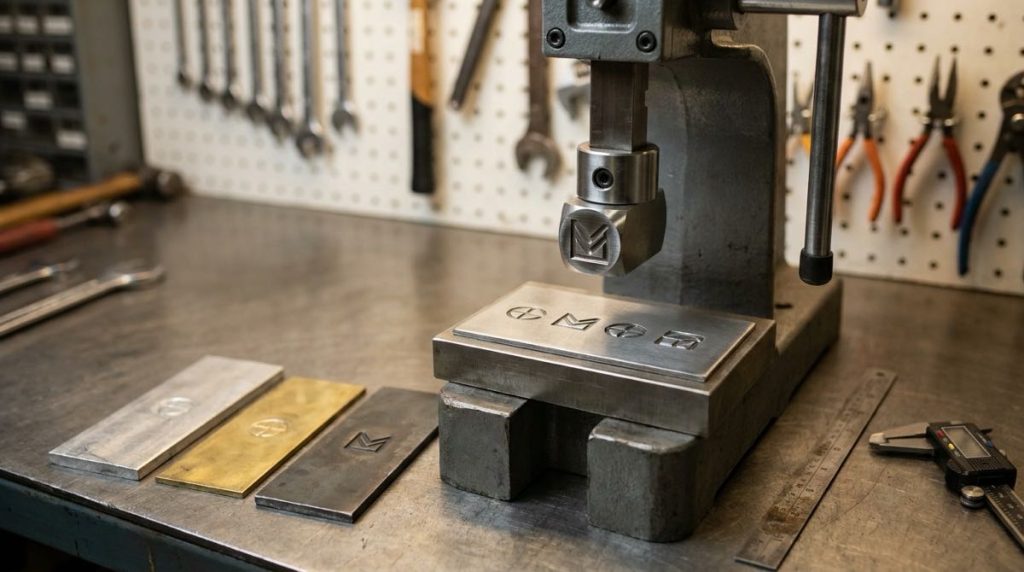
No marking standard says how many tons a machine stamp needs, because standards govern the finished impression, not the force that produced it. Devore’s guide to hand stamp striking force makes the same point for hammer work, and it matters more with presses: the answer is a method, not a rule of thumb. The method is to estimate force from the stamp’s contact area and the material’s hardness, then prove it on scrap before production.
Marking press tonnage is a rating of force, so it only means something against the area the force acts on. Hardness is the other input, and NIST is the U.S. national authority for hardness measurement traceability, which makes a hardness value from your material certificate the right place to start. This guide covers what sets the force, how to choose a delivery method, and what to send Devore so a stamp matches your press. For the stamps themselves, see Devore’s custom metal machine stamps.
What Sets the Force a Machine Stamp Needs?
Four inputs compound, and the one driving your job tells you what to adjust.
- Total face area in contact: force spreads across every character touching the part, so a long line of characters receives a fraction of the pressure a single character would.
- Characters per strike: this is the same principle as it shows up on the floor. A full part number ordered as one line stamp may not seat on the material you have in mind, and splitting the mark across two strikes or moving to press assistance resolves it.
- Material hardness: harder material resists displacement, and below a certain point the characters will not form fully.
- Character geometry: fine, thin strokes penetrate more readily than heavy block characters of the same height, because the same force concentrates into less contact area.
Devore also builds machine stamps around the marking method, machine setup, and engraving depth, so those belong in the same conversation.
Count the Contact Area First, Because It Multiplies Everything
A working estimate is that required force equals contact area times the pressure the material demands at your target depth. Contact area is the sum of the engraved strokes that touch the part in one strike, not the footprint of the stamp body. Ten characters of the same size struck together carry about ten times the contact area of one, so they need about ten times the force for the same depth.
The pressure term is not one fixed number. It moves with hardness, depth, stroke width, and engraving angle, which is why the setting is confirmed by test instead of read from a table.
How Does Material Hardness Move the Requirement?
Aluminum needs low to moderate force, brass and copper moderate, mild steel moderate to high, stainless high, and hardened or heat-treated steel the highest. Each fails in a different direction when the force is wrong. Aluminum dishes around the mark and bulges on the back of thin stock, mild steel gives shallow characters that are incomplete at the edges, and stainless work hardens, so a second strike meets more resistance than the first. Hardened steel may not form characters fully at any available force. The table in the hand stamp force guide ranks more materials, including wood and plastics.
Choose the Delivery Method by Repeatability, Not Only Force
Force can be delivered three ways, and the choice depends on how consistent the mark has to be.
| Delivery Method | How Force Is Controlled | Best Fit |
|---|---|---|
| Hammer | Varies with operator fatigue and position | Field marking, low volume, parts that cannot come to a bench |
| Arbor press | Steady applied pressure that is controllable and repeatable | Hard materials, long line stamps, runs where every part must match |
| Pneumatic or hydraulic machine stamp system | Automates the impact, so force does not depend on the operator | Higher volumes, faster cycles, less operator fatigue |
The guide to integrating stamp marking into production covers the fixtures, training, and quality checks around these systems.
Why Set Depth Before You Size the Press?
Depth is a specification decision, not a press setting. Set it from legibility and part-strength requirements, then size the force to reach it. Deeper impressions displace more material, which takes more force and puts more stress in the part. Devore’s guide to choosing character size and marking depth covers how to set it.
Support the Part, or the Press Spends Force Moving It
Force that moves the part does not go into the impression. A workpiece resting on a soft surface, spanning a gap, or clamped at one end absorbs part of every blow, which reads as needing more force than the material should require. Solid backing directly under the marking area usually lowers the force needed, and thin stock needs support under the mark to keep the impression clean and prevent a bulge on the reverse side.
How Do You Prove the Setting Before Production?
Establish the setting on scrap of the same material and thickness, then lock it in before touching production parts.
- Start below the force you expect to need.
- Raise it in small, consistent increments, with one strike per test and an inspection between attempts.
- Stop at the first impression that meets the depth and legibility requirement, because the best-looking sample is often already past the point of distortion.
- Record the press setting, the stamp and holder, the backing arrangement, and the part orientation, so the mark repeats across shifts and operators.
If a sample shows defects, the guide to steel stamp marking problems links each symptom to its cause.
What Should You Send So the Stamp Matches Your Press?
Devore recommends stamp configurations around the force you have available, so the press details belong in the request. Send as much of this as you have:
- The press or marking system and the force or pressure it delivers
- The material, its hardness if known, and its thickness
- The mark content and how many characters strike at once
- The depth you need
- How the stamp mounts: holder, shank, or fixture
- Volume and deadline
Tell Devore the material, thickness, mark content, and the force you have available, and the team will recommend a configuration that works with it. Request a quote or call 330-454-6820.
