
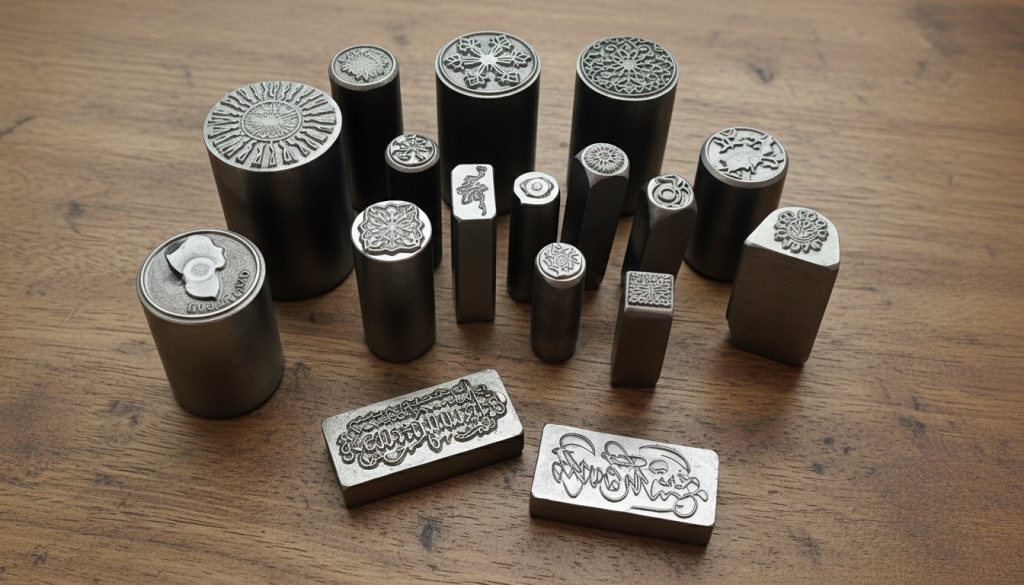
When you need to permanently mark your company logo, brand symbol, or custom graphics on manufactured parts, the quality of the mark reflects directly on your brand. A crisp, professional logo stamp creates confidence. A poorly executed mark suggests carelessness—even if your products are flawless.
Many manufacturers discover too late that logos designed for print or digital media don’t translate well to steel stamps. Fine details disappear, thin lines break up, and complex gradients become muddy blobs. The result is illegible marks that fail to achieve their purpose.
According to research from the International Organization for Standardization (ISO), permanent marking and identification systems must meet minimum legibility requirements to support effective [traceability and quality management](https://www.iso.org/). Their standards emphasize that marks must remain clear and readable throughout a product’s lifecycle—a goal that starts with proper design.
At Devore Engraving, we’ve helped thousands of customers adapt their logos and graphics for steel stamp marking since 1963. Our experience has taught us which design elements work and which cause problems. This guide explains how to design or adapt graphics for optimal results when using [custom logo stamps](https://devoreengraving.com/products/custom-logo-engraving-stamp/).
## Why Logo Design for Stamps Differs from Other Media
Logos created for business cards, websites, or packaging face different constraints than those destined for steel stamps. Understanding these differences prevents frustration and ensures successful results.
**Resolution and Detail Limitations**
Print and digital logos can include extremely fine details—hairline borders, subtle gradients, tiny text. Steel stamps, however, are physical three-dimensional tools that create marks through material displacement. Physical constraints limit achievable detail:
– Minimum practical line width: 0.010″ to 0.015″ (0.25mm to 0.38mm)
– Minimum spacing between features: 0.015″ to 0.020″ (0.38mm to 0.50mm)
– Minimum character height for legibility: 0.080″ to 0.100″ (2.0mm to 2.5mm)
Details finer than these limits either won’t engrave clearly or won’t transfer to marked parts effectively.
**Material Behavior During Marking**
When stamps impact metal surfaces, material flows and displaces. This physical process differs fundamentally from printing ink or displaying pixels:
– Sharp corners may not form perfectly as material flows around them
– Very thin features can fill in or disappear entirely
– Closely-spaced elements may merge together
– Complex internal details in small characters become illegible
**Durability Concerns**
Stamped logos must survive not just marking but also the part’s entire service life:
– Handling and abrasion gradually wear shallow details
– Environmental exposure (weather, chemicals) affects mark visibility
– Manufacturing processes after marking may degrade fine features
Designing for durability means emphasizing clear, bold features over intricate complexity.
## Essential Design Principles for Steel Stamps
Follow these guidelines when creating or adapting logos for stamp marking.
## Simplify Complex Designs
**Reduce Element Count**
Logos with dozens of individual elements create manufacturing challenges and often produce unclear marks. Simplify to core recognizable features:
– Identify the minimum elements needed for brand recognition
– Eliminate decorative details that don’t add to identification
– Combine separate elements into unified shapes when possible
**Remove Fine Details**
Elements that look great at 2″ diameter on a business card may be impossible to reproduce at 1/2″ diameter on a stamp:
– Eliminate hairline borders and thin accent lines
– Remove small interior details within shapes
– Simplify intricate patterns into bolder representations
**Avoid Gradients and Shading**
Stamps create binary marks—impressed or not impressed. They can’t reproduce:
– Color gradients
– Shading effects
– Multiple depth levels (without complex embossing)
– Photography or photorealistic rendering
Convert these elements to solid shapes, outlines, or eliminate them entirely.
## Optimize Line Weights and Spacing
**Minimum Line Width**
– **For marks under 1/2″ (13mm)**: Minimum 0.015″ (0.38mm) line width
– **For marks 1/2″ to 1″ (13mm to 25mm)**: Minimum 0.020″ (0.50mm) line width
– **For marks over 1″ (25mm)**: Minimum 0.030″ (0.76mm) line width
Thinner lines may not transfer clearly or may wear rapidly.
**Consistent Line Weight**
Logos with widely varying line weights (thick outlines, thin details) can cause problems:
– Thick lines require more impact force to mark completely
– Thin lines may not mark at all with force appropriate for thick lines
– Result is partially formed logos with some features clear, others missing
Aim for line weight variation no more than 2:1 ratio.
**Adequate Spacing**
Space between elements should equal or exceed the narrower element’s width:
– If lines are 0.020″ wide, space them at least 0.020″ apart
– Closer spacing risks elements merging during marking
– Consider that material flow during impact can slightly enlarge features
## Text Considerations in Logos
**Minimum Text Size**
Text within logos must be large enough to read clearly:
– **Minimum practical text height**: 0.100″ (2.5mm) for simple fonts
– **Recommended minimum**: 0.125″ to 0.150″ (3.2mm to 3.8mm) for reliability
– **Complex fonts**: May need 0.200″ (5mm) or larger
Text smaller than these limits becomes illegible, defeating its purpose.
**Font Selection**
Not all fonts translate well to steel stamps:
**Good Font Characteristics**
– Sans-serif designs (cleaner reproduction)
– Consistent stroke width
– Open counters (interior spaces in letters like O, P, R)
– Adequate spacing between letters
– Simple, bold letterforms
**Problematic Font Characteristics**
– Thin, delicate serifs
– Ornate or script styles
– Tightly-compressed letter spacing
– Very light or very heavy weights
– Small internal details
For [part number marking](https://devoreengraving.com/how-to-permanently-mark-part-numbers-with-custom-hand-stamps/) or [serial numbers](https://devoreengraving.com/traceability-made-easy-using-hand-stamps-for-serial-numbers/) within logos, prioritize legibility over decorative appearance.
## Converting Existing Logos for Stamp Use
Most companies already have established logos. Converting them for stamp marking requires thoughtful adaptation.
**Start with Vector Files**
Provide your logo in vector format (AI, EPS, or PDF) rather than raster formats (JPG, PNG). Vector files:
– Maintain clarity at any size
– Allow precise measurement and adjustment
– Simplify manufacturing process
– Ensure accuracy in reproduction
If you only have raster files, professional vectorization may be necessary before creating stamps.
**Simplification Process**
**Step 1: Assess Current Design**
Evaluate your logo against the guidelines above:
– Identify elements that are too fine or complex
– Note areas where spacing is inadequate
– Determine if text is large enough
– Consider how the design will look at actual stamp size
**Step 2: Create Stamp-Friendly Version**
Develop an adapted version specifically for stamping:
– Thicken thin lines to minimum widths
– Increase spacing between elements
– Enlarge or simplify text
– Remove or simplify problematic details
**Step 3: Validate at Actual Size**
Print your adapted design at the actual stamp size (full scale, 100%):
– Can you clearly distinguish all elements?
– Does text remain legible?
– Do closely-spaced features maintain separation?
– Would marks be recognizable if partially worn?
If any answer is “no,” simplify further.
**Maintain Brand Recognition**
The goal is creating a stamp-appropriate version while preserving brand identity. This often means:
– Retaining overall shape and layout
– Keeping key recognizable elements
– Preserving essential text (company name, critical identifiers)
– Accepting that stamped versions won’t have every detail of print logos
Many companies maintain separate logo versions for different applications. A stamped logo version is a legitimate variant.
## Size Considerations
Logo stamp size significantly affects design feasibility and performance.
**Small Logos (Under 1/2″ or 13mm)**
At very small sizes, only extremely simple designs work:
– Bold shapes without interior details
– No text or minimal text (2-4 characters maximum)
– Wide line weights relative to overall size
– Maximum simplification required
Consider whether marking just a symbol (no text) maintains adequate brand recognition.
**Medium Logos (1/2″ to 1″ or 13mm to 25mm)**
This size range accommodates most simplified industrial logos:
– Simple graphics with limited detail
– Brief text (company initials, short names)
– Balance between brand recognition and practical marking
– Most common size for [automotive](https://devoreengraving.com/industries-served/automotive-metal-engraving/) and industrial applications
**Large Logos (Over 1″ or 25mm)**
Larger stamps allow more design complexity:
– More detailed graphics remain distinguishable
– Longer text or taglines become feasible
– Greater design freedom while maintaining clarity
– Consideration: Larger stamps require more impact force to mark, which matters more for hand-driven marking than for [machine stamps](https://devoreengraving.com/machine-stamps-vs-hand-stamps/) running on a press
Balance design ambitions against practical marking limitations for your specific application.
## Material and Surface Impact on Logo Design
The material you’re marking influences optimal logo design.
**Soft Materials (Aluminum, Brass, Copper)**
– Accept finer details more readily
– Allow smaller features and tighter spacing
– Provide clear contrast in marks
– Permit more design complexity
**Hard Materials (Steel, Stainless Steel)**
– Require bolder, simpler designs
– Need wider spacing and heavier line weights
– May not reproduce very fine details clearly
– Favor robust, straightforward graphics
The stamp’s own steel grade matters here too — softer, more machinable tool steels reproduce fine logo detail more reliably than harder, wear-resistant grades. See our [guide to steel grades for custom stamps](https://devoreengraving.com/understanding-steel-grades-for-custom-stamps-which-material-is-right-for-your-application/) for how material choice affects achievable detail.
**Surface Finish Considerations**
**Rough or Textured Surfaces**
– Details disappear into surface texture
– Require deeper marks and bolder features
– May need significant design simplification
– Consider whether marking is appropriate on very rough surfaces
**Smooth or Polished Surfaces**
– Reproduce fine details more clearly
– Allow more design complexity
– May need shallower marks (to minimize cosmetic impact)
– Excellent for showcasing detailed logos when appropriate
For [medical device](https://devoreengraving.com/custom-stamps-for-the-medical-device-and-electronics-markets/) applications requiring both detailed logos and smooth finishes, this balance becomes particularly important.
## Testing and Validation
Never commit to production stamp manufacturing without validation.
**Digital Mockups**
Create full-scale printouts of your proposed stamp design:
– Print at 100% scale (no reduction or enlargement)
– View at normal working distance
– Evaluate legibility and clarity
– Share with others for independent assessment
**Sample Stamps**
For critical applications, request sample stamps for testing:
– Test on actual production materials
– Evaluate mark clarity and durability
– Verify legibility after marking
– Test under actual production conditions
At Devore Engraving, we can create test stamps allowing validation before committing to production quantities. This small investment prevents expensive mistakes.
**Iterative Refinement**
First designs rarely achieve perfect results. Expect to refine:
– Adjust line weights based on test results
– Modify spacing if elements merge
– Simplify areas that don’t transfer well
– Optimize for production conditions
## Special Logo Applications
Different marking scenarios have unique logo design requirements.
**[Embossing Dies](https://devoreengraving.com/products/emboss-dies-sets/)**
Embossing creates raised rather than recessed marks. Design considerations include:
– Different visual effect than standard stamping
– May allow slightly finer detail
– Works particularly well for branding applications
– Creates distinctive tactile element
**[Roll Dies](https://devoreengraving.com/products/roll-stamping-marking-dies/)**
For marking cylindrical parts (pipes, shafts, tubes):
– Logo must wrap around curved surface
– Design may need compression or stretching to account for curvature
– Very long, thin logos work better than tall, compact designs
– Consider how logo appears when part rotates
**Multi-Color or Filled Logos**
Some industries fill stamped logos with paint or ink for visibility:
– Design must include recessed areas suitable for filling
– Consider how filled version will look
– Ensure adequate depth for filling process
– Plan cleanup and maintenance of filled marks
## Common Logo Design Mistakes
Learn from others’ errors to avoid these frequent problems.
**Mistake 1: Direct Conversion from Digital Files**
Taking a website logo and ordering stamps without adaptation produces poor results.
**Solution**:
Create stamp-specific versions following guidelines above.
**Mistake 2: Ignoring Actual Size**
Designs that look fine at 3″ diameter on screen fail at 1/2″ actual stamp size.
**Solution**:
Always evaluate designs at 100% actual size.
**Mistake 3: Too Much Detail**
Trying to include every element from complex logos creates illegible marks.
**Solution**:
Simplify ruthlessly, keeping only essential brand-identifying elements.
**Mistake 4: Inadequate Line Weight**
Thin, delicate lines don’t survive manufacturing or marking processes.
**Solution**:
Use minimum line weights appropriate for your stamp size.
**Mistake 5: Poor Font Selection**
Decorative or script fonts become illegible at small sizes.
**Solution**:
Choose simple, bold fonts designed for clarity.
## Industry-Specific Considerations
Different industries have particular logo marking requirements.
**[Automotive Industry](https://devoreengraving.com/industries-served/automotive-metal-engraving/)**
– Logos must survive harsh environments
– Often marked on hard materials requiring robust designs
– Regulatory requirements may mandate specific elements
– Focus on durability over decorative complexity
**[Railroad Components](https://devoreengraving.com/industries-served/railroad-stamping-dies/)**
– Large parts allow larger stamps and more detail
– Marks must withstand decades of outdoor exposure
– Bold, simple designs ensure long-term legibility
– Consider visibility from distance
**[Food and Beverage Packaging](https://devoreengraving.com/how-canning-manufacturers-use-hand-stamps-for-compliance-and-quality-control/)**
– Logos on cans and containers need clean, sanitary appearance
– Marks must survive processing and distribution
– Simple designs reduce contamination concerns
– Consider how logos appear after filling, sealing, labeling
**Medical Devices**
– Logos must not compromise sterilization or cleaning
– Smooth surfaces favor finer detail but require shallow marks
– Regulatory marking requirements may accompany logos
– Consider bio-compatibility if marks contact patients
## Working with Devore Engraving on Logo Design
Our process ensures optimal results:
**Initial Consultation**
We discuss your marking application:
– What materials are you marking?
– What size stamp do you need?
– Where will marks be located on parts?
– What environmental conditions will marked parts experience?
**Design Review**
Send us your current logo. We evaluate:
– Which elements will transfer well to stamps
– What modifications would improve results
– Whether additional simplification is needed
– Optimal sizing for your application
**Adaptation Recommendations**
We provide specific guidance:
– Suggested line weight adjustments
– Element spacing recommendations
– Text size optimization
– Alternative layouts if needed
**Sample Production** (when appropriate)
For critical applications, we can create:
– Sample stamps for testing
– Test marks on your materials
– Multiple design variations for comparison
**Production and Support**
Once design is finalized:
– Precise CNC engraving ensures accuracy
– Proper heat treatment delivers durability
– Complete documentation provided
– Ongoing support for any questions or issues
## File Format and Submission Guidelines
To facilitate stamp manufacturing, provide:
**Preferred Formats**
– Adobe Illustrator (.AI)
– Encapsulated PostScript (.EPS)
– Scalable Vector Graphics (.SVG)
– PDF (vector, not rasterized)
**File Preparation**
– Convert all text to outlines/paths
– Ensure all elements are vector (not embedded raster images)
– Include dimensions or specify desired stamp size
– Provide color versions and black & white versions
– Include any special instructions about critical elements
**Communication**
Clearly explain:
– Intended application and use case
– Any regulatory or compliance requirements
– Quality expectations
– Production timeline needs
## Conclusion: Design Determines Success
Logo stamp performance starts with proper design. While adapting complex modern logos for steel stamp marking requires compromises, thoughtful design ensures your marks remain professional, legible, and durable throughout your parts’ service lives.
The key is understanding physical constraints and designing within them rather than fighting against them. A well-designed stamp-appropriate logo makes a better impression than a poorly-executed attempt to reproduce every detail of your complete corporate identity.
At Devore Engraving, we’re committed to helping you create [custom logo stamps](https://devoreengraving.com/products/custom-logo-engraving-stamp/) that effectively represent your brand on your products. Whether you need [hand stamps](https://devoreengraving.com/products/custom-hand-stamps/) for low-volume marking or stamps for [traceability marking](https://devoreengraving.com/the-basics-of-traceability-in-manufacturing-and-why-it-matters/), [part identification](https://devoreengraving.com/how-to-permanently-mark-part-numbers-with-custom-hand-stamps/), or brand recognition, our experience ensures designs that work.
Ready to create professional logo stamps for your products? Contact us today to discuss your requirements. Send us your logo files and application details, and we’ll provide expert guidance on creating stamp designs that deliver clear, durable marks you’ll be proud to put on your products.
Request a quote now and let our 60+ years of experience ensure your logo marks represent your brand with the quality it deserves.
