
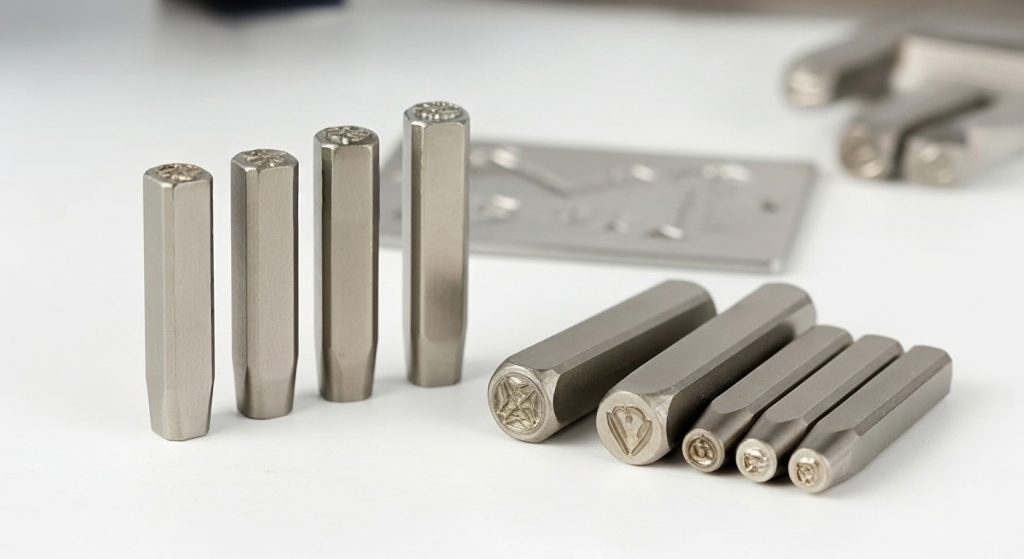
Mark depth might seem like a minor detail when ordering custom steel stamps, but it’s actually one of the most critical specifications affecting mark quality, longevity, and readability. Too shallow, and your marks fade quickly or become illegible under normal wear. Too deep, and you risk damaging parts, creating stress concentrations, or violating dimensional tolerances.
The American Society for Testing and Materials (ASTM) publishes standards for various marking methods and their effects on material properties. Their guidelines on permanent marking and identification emphasize that proper mark depth selection balances visibility requirements with material integrity concerns.
At Devore Engraving, we’ve spent over 60 years helping manufacturers determine optimal mark depths for thousands of different applications. This technical guide explains how to select mark depths that ensure your identifications remain legible throughout the part’s service life without compromising structural integrity.
Why Mark Depth Matters
Mark depth affects three critical factors:
Legibility and Contrast
Deeper marks create more shadow and contrast, making characters easier to read. However, the relationship isn’t linear—beyond a certain depth, additional depth adds little to readability while increasing manufacturing cost and part stress.
Mark Permanence
Surface marks wear away quickly on parts exposed to abrasion, handling, or environmental conditions. Adequate depth ensures marks survive throughout the component’s intended lifespan.
Structural Integrity
Every mark removes material and creates a stress concentration. In high-stress applications or on thin materials, overly deep marks can compromise part strength or initiate crack formation.
Understanding Mark Depth Terminology
Before diving into selection criteria, let’s clarify terminology. When we discuss mark depth, we’re referring to how far the stamp penetrates into the base material surface, measured from the original surface level to the deepest point of the impression.
Common depth ranges:
- Shallow marks: 0.002″ to 0.005″ (0.05mm to 0.13mm)
- Standard marks: 0.005″ to 0.015″ (0.13mm to 0.38mm)
- Deep marks: 0.015″ to 0.030″ (0.38mm to 0.76mm)
- Extra-deep marks: 0.030″ and beyond (0.76mm+)
These ranges serve as general guidelines. Your optimal depth depends on multiple application-specific factors we’ll explore below.
Material Considerations
The material being marked dramatically influences appropriate mark depth selection.
Soft Materials (Aluminum, Brass, Copper, Plastics)
Soft materials deform easily under impact, making them simple to mark but also prone to wear. For these materials:
- Minimum recommended depth: 0.005″ to 0.008″ for protected indoor parts
- Standard depth: 0.010″ to 0.015″ for general industrial use
- Maximum depth: Limited by material thickness and stress concerns
Soft materials allow deeper marking without excessive impact force, but their low hardness means surface wear occurs faster. If marking aluminum parts that undergo frequent handling, specify depths toward the deeper end of the range.
Custom hand stamps work well on soft materials because the operator can modulate strike force to achieve consistent depth without specialized equipment.
Medium-Hardness Materials (Mild Steel, Low-Carbon Steel)
These common industrial materials balance markability with durability:
- Minimum recommended depth: 0.008″ to 0.010″ for indoor applications
- Standard depth: 0.012″ to 0.020″ for most industrial marking
- Maximum depth: 0.030″ for heavy-duty applications on thick sections
Medium-hardness steels accept marks readily and retain them well. This material class represents the majority of parts we mark at Devore Engraving, making these depth specifications widely applicable.
Hard Materials (Hardened Steel, Stainless Steel, Tool Steel)
Marking hardened materials requires more impact force and careful depth control:
- Minimum recommended depth: 0.003″ to 0.005″ (often the practical maximum with hand stamps)
- Standard depth: 0.005″ to 0.010″ for machine stamp applications
- Maximum depth: 0.015″ for specialized applications using powerful marking equipment
Hardened materials resist deformation, limiting achievable mark depth. Fortunately, their hardness also means marks wear very slowly, so shallow depths provide adequate permanence.
Special Materials (Titanium, Exotic Alloys)
Aerospace and medical applications often use titanium or high-performance alloys. These materials require careful depth specification:
- Mark depths typically 0.003″ to 0.008″
- Medical device manufacturers must ensure marks don’t create crevices that compromise sterilization
- Aerospace applications must prevent stress concentrations that could initiate fatigue cracks
Application Environment and Wear Resistance
The environment where marked parts operate significantly affects required mark depth.
Protected Indoor Environments
Parts used in clean, controlled environments (electronics assembly, office equipment, indoor machinery) experience minimal abrasive wear. These applications allow shallower marks:
- Standard depths of 0.005″ to 0.010″ typically sufficient
- Focus on legibility rather than extreme durability
- Cost savings from reduced impact force requirements
Industrial Production Environments
Manufacturing facilities expose parts to handling, contact with tooling, and general wear. Specify moderate depths:
- Standard depths of 0.010″ to 0.015″ recommended
- Balance between legibility and mark survival through production processes
- Consider part number and serial number marking that must survive through assembly and quality inspection
Harsh Outdoor Environments
Railroad components, construction equipment, and marine applications face severe conditions—weather exposure, dirt, debris, and heavy mechanical wear. These demand deeper marks:
- Minimum depths of 0.015″ to 0.020″
- Deep marks of 0.025″ to 0.030″ for critical identification that must survive decades
- Consider environmental corrosion when specifying depths
High-Abrasion Applications
Parts subjected to sliding contact, material handling, or aggressive cleaning processes need maximum mark depth:
- Depths of 0.020″ to 0.030″ or more
- May require special marking methods or protected marking locations
- Consider alternative identification methods (tags, plates) if marks won’t survive
Part Geometry and Structural Considerations
Mark depth must account for the part’s geometry and structural requirements.
Thin-Walled Parts
Marking thin sections creates unique challenges:
- General rule: Mark depth should not exceed 10-15% of wall thickness
- Example: 0.050″ wall thickness limits marks to approximately 0.005″ to 0.008″
- Deeper marks risk distortion, breakthrough, or structural weakness
- Consider marking in reinforced areas or on flanges rather than thin walls
Critical Stress Areas
Avoid deep marks in areas experiencing high loads or cyclical stressing:
- Reduce mark depth by 30-50% in stress-critical zones
- Consult with structural engineers for fatigue-critical parts
- Consider relocating marks to lower-stress areas if possible
Cosmetic Surfaces
Parts with appearance requirements need careful depth selection:
- Shallower marks (0.003″ to 0.008″) minimize visual impact
- Consider mark location visibility from normal viewing angles
- Balance aesthetics with traceability requirements
Regulatory and Compliance Requirements
Many industries mandate specific marking depths or permanence standards.
Automotive Industry Standards
Automotive traceability requirements typically specify:
- Minimum mark depths of 0.010″ to 0.015″ for critical components
- Marks must survive vehicle lifetime (10+ years, 150,000+ miles)
- Testing requirements to validate mark permanence
Aerospace Requirements
Aerospace marking must meet stringent specifications:
- Mark depths typically 0.005″ to 0.010″ maximum to avoid stress concentrations
- Documentation required for all marking on critical parts
- Non-destructive testing may be required after marking
Medical Device Regulations
Medical device marking must balance permanence with cleanability:
- Depths generally 0.003″ to 0.008″
- Marks must not create crevices where contaminants accumulate
- Must survive sterilization cycles without degradation
Food and Beverage Industry
Canning and food packaging marking requirements include:
- Sufficient depth to remain legible through processing and distribution
- Marks must not compromise container integrity or food safety
- Typical depths 0.008″ to 0.015″ depending on substrate
Character Size and Mark Depth Relationship
Character size influences optimal mark depth. Larger characters typically require proportionally deeper marks for proper visual impact.
Small Characters (Under 1/8″ / 3mm tall)
- Recommended depth: 0.003″ to 0.008″
- Deeper marks on small characters can cause filling or loss of definition
- Critical for small machine stamps on precision parts
Medium Characters (1/8″ to 1/4″ / 3mm to 6mm tall)
- Recommended depth: 0.008″ to 0.015″
- Most common size range for industrial marking
- Well-balanced proportion between character height and mark depth
Large Characters (Over 1/4″ / 6mm tall)
- Recommended depth: 0.015″ to 0.030″
- Larger characters need deeper marks to maintain visual impact
- Common on large industrial stamps for equipment identification
Rule of Thumb
A practical guideline: mark depth should be approximately 5-10% of character height for optimal legibility and permanence. This ratio provides good shadow definition without excessive material removal.
Impact Force and Equipment Limitations
Mark depth achievement depends on available impact force and marking method.
Hand Stamping Limitations
With hand stamps and manual striking:
- Soft materials (aluminum, brass): 0.010″ to 0.020″ readily achievable
- Medium materials (mild steel): 0.008″ to 0.015″ achievable with good technique
- Hard materials (hardened steel): 0.003″ to 0.008″ maximum practical depth
- Operator fatigue increases with required impact force
Arbor Press Marking
Mechanical arbor presses provide controlled force:
- More consistent depth control than hand striking
- Can achieve 0.015″ to 0.025″ on medium materials
- Suitable for moderate production volumes
- Limited by press capacity and part accessibility
Pneumatic/Hydraulic Marking Systems
Powered marking equipment delivers consistent, high-force impacts:
- Achievable depths up to 0.030″ or more on appropriate materials
- Excellent depth consistency part-to-part
- Machine stamp systems ideal for high-volume production
- Programmable force control for precision depth management
Surface Finish Effects on Optimal Depth
Surface condition before marking affects both mark appearance and optimal depth selection.
Rough or As-Cast Surfaces
Rough surfaces require deeper marks for adequate visibility:
- Increase standard depth specification by 50-100%
- Deep marks overcome surface irregularities
- Consider surface preparation (grinding, machining) before marking if precision matters
Machined or Ground Surfaces
Smooth, prepared surfaces show marks clearly even at shallow depths:
- Can use minimum depth specifications
- Better definition and cleaner mark appearance
- Ideal for precision part identification
Polished or Plated Surfaces
Highly finished surfaces may actually show shallow marks more clearly:
- Depths of 0.003″ to 0.008″ often sufficient
- Deeper marks may be aesthetically undesirable
- Consider marking before plating if depth is limited by cosmetic concerns
Coated or Painted Surfaces
If marking through coatings:
- Mark depth must exceed coating thickness plus desired depth in base material
- Example: 0.005″ paint + 0.010″ desired base depth = 0.015″ total
- Coating may fill marks over time; specify additional depth for long-term legibility
Testing and Validation
Never rely solely on calculations when critical marking is involved. Physical testing validates your depth selection.
Sample Part Testing
Request test marking on actual production parts or representative samples:
- Evaluate legibility at normal viewing distances and angles
- Assess mark appearance and contrast
- Verify depth consistency across multiple impressions
- Test marks under simulated service conditions
Accelerated Wear Testing
For parts in abrasive or harsh environments:
- Subject marked samples to accelerated wear (abrasion testing, salt spray, cycling)
- Measure mark depth before and after exposure
- Calculate projected mark life and adjust initial depth accordingly
- Document testing for quality records and customer requirements
Dimensional Inspection
Verify marks don’t violate part tolerances:
- Measure actual mark depth with profilometer or depth gauge
- Confirm no distortion in adjacent areas
- Check flatness/straightness if marks are on precision surfaces
- Document results for automotive or aerospace quality systems
Common Mark Depth Mistakes and How to Avoid Them
Mistake 1: Specifying Depth Without Considering Material
Solution: Always match depth specification to material hardness and application environment. What works for aluminum won’t work for hardened steel.
Mistake 2: Ignoring Part Thickness
Solution: Calculate maximum safe depth as percentage of wall thickness before finalizing specifications.
Mistake 3: Overlooking Environmental Wear
Solution: Add 50-100% to minimum theoretical depth for parts in abrasive or outdoor environments.
Mistake 4: Assuming Deeper Is Always Better
Solution: Recognize that excessive depth increases costs, marking time, and structural concerns without proportional benefit.
Mistake 5: Not Testing Before Production
Solution: Always test mark depth on sample parts before committing to production quantities of stamps.
Adjusting Depth for Different Marking Methods
Different marking approaches have unique depth control considerations.
Standard Impact Marking
Most common method using steel stamps:
- Depth controlled by impact force
- Repeatable with proper equipment and technique
- Suitable for all depth ranges depending on equipment
Roll Marking
Roll dies for cylindrical parts:
- Depth controlled by roll pressure and multiple passes if needed
- Generally limited to 0.005″ to 0.015″ range
- Excellent for marking pipes, shafts, and tubes
Embossing
Embossing dies create raised rather than recessed marks:
- Effective depths typically 0.005″ to 0.020″
- Used more for branding than functional identification
- Material displacement rather than removal
Industry-Specific Depth Recommendations
Based on decades of experience across multiple sectors:
Automotive Components
- Engine parts: 0.015″ to 0.020″
- Body panels: 0.008″ to 0.012″
- Fasteners: 0.010″ to 0.015″
Railroad Equipment
- Structural components: 0.020″ to 0.030″
- Wheels and axles: 0.015″ to 0.025″
- Coupling parts: 0.018″ to 0.025″
Medical Devices
- Surgical instruments: 0.003″ to 0.006″
- Implants: 0.002″ to 0.005″
- Equipment housings: 0.008″ to 0.012″
Food Processing Equipment
- Stainless components: 0.008″ to 0.012″
- Packaging machinery: 0.010″ to 0.015″
- Canning equipment: 0.012″ to 0.018″
Working with Devore Engraving to Specify Optimal Depth
Our team helps customers determine the right mark depth through:
Application Analysis
We review your material, environment, part geometry, and requirements to recommend appropriate depths.
Testing Services
We can create test stamps at multiple depths, allowing you to evaluate options before committing to production tooling.
Engineering Support
Our engineers calculate safe maximum depths considering your part’s structural requirements and tolerances.
Documentation
We provide detailed specifications and test results for quality systems and compliance documentation.
Conclusion: Precision Depth Selection Ensures Long-Term Success
Mark depth significantly impacts the success of your permanent identification system. Too shallow, and marks fade before the part’s useful life ends. Too deep, and you risk part integrity, excessive costs, or cosmetic issues.
The optimal depth balances multiple factors: material properties, environmental conditions, regulatory requirements, part geometry, and available marking equipment. By carefully considering these factors and conducting validation testing, you ensure marks that remain legible and compliant throughout the part’s intended service.
At Devore Engraving, we’ve helped thousands of customers specify mark depths that deliver lasting results. Whether you need custom hand stamps for field marking or machine stamps for automated production lines, our engineering team provides guidance based on proven experience across diverse applications.
Ready to specify the right mark depth for your application? Contact us to discuss your requirements. We’ll help you determine specifications that deliver clear, durable marks optimized for your specific parts and operating environment.
