
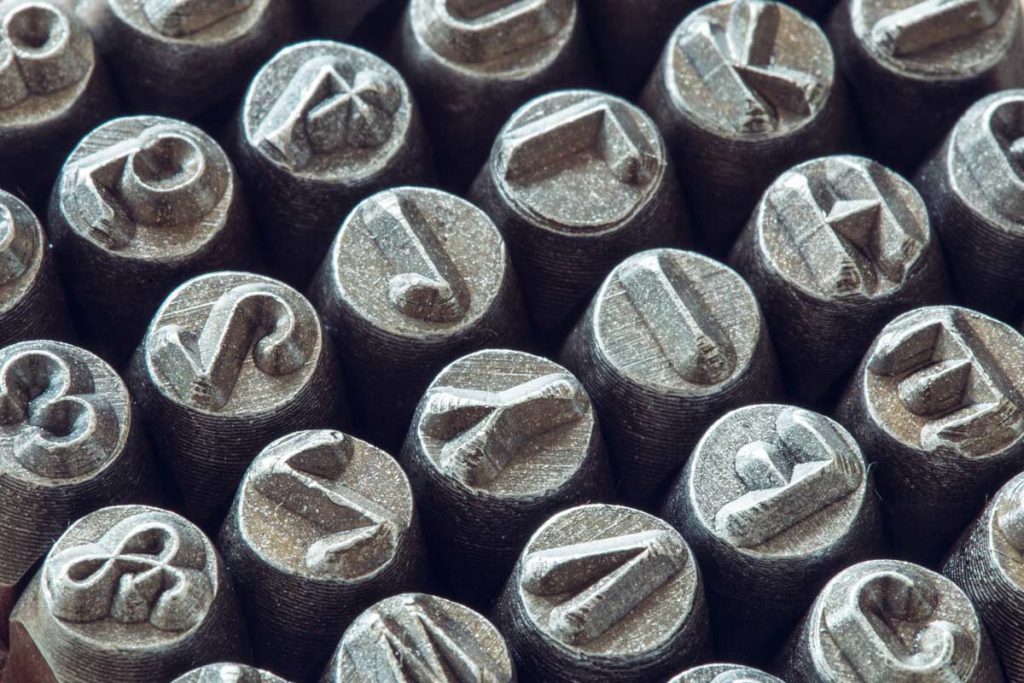
Choosing the right size for your custom stamp is more than a matter of preference—it directly impacts legibility, durability, and the overall success of your marking application. Whether you’re stamping metal parts, leather goods, plastic components, or wooden pieces, selecting the correct size ensures your markings are clear, permanent, and appropriately scaled to your material.
At Devore Engraving, we manufacture custom steel stamps in a range of sizes to meet the diverse needs of industrial clients, artisans, and manufacturers. But how do you know whether you need a small, medium, or large stamp?
Sizing is a compliance question before it is a preference question. MIL-STD-130N, the Department of Defense standard for identification marking of U.S. military property, sets a recommended minimum character height of 0.08 inches for human-readable text in Table I of the standard. Commercial applications are rarely that strict, but the principle holds: there is a floor below which a mark stops doing its job. This guide walks through application type, material, detail level, and machine compatibility so you can land above that floor on the first order.
Understanding Stamp Sizes
Stamp size generally refers to the engraved face area used to mark the material. It is usually measured in inches or millimeters and can be broken down into three general categories:
- Small stamps: 1/32″ to 1/8″ character height or face size
- Medium stamps: 5/32″ to 3/8″
- Large stamps: 1/2″ and above
These categories aren’t rigid but serve as a helpful reference point when matching your stamp to the intended application.
Small Stamps: Precision for Tight Spaces
Small stamps are ideal when space is limited or the marking needs to be subtle, such as for serial numbers, jewelry logos, or part IDs on electronics. They are often used with hand stamps or compact marking machines designed for low-force applications.
Use Cases for Small Stamps
- Jewelry and watchmaking
- Electronics and circuit boards
- Small tools and fasteners
- Serial numbers or lot codes
Advantages
- Great for precision work and tight spaces
- Creates subtle, professional markings
- Minimizes distortion on thin or delicate materials
Considerations
- Can be difficult to read on textured or dark surfaces
- Requires careful alignment and controlled pressure
Medium Stamps: The Most Versatile Size
Medium-sized stamps strike a balance between legibility and flexibility. They are commonly used across industries for part identification, logo branding, date coding, and general-purpose marking. They work well in both hand and machine applications.
Use Cases for Medium Stamps
- Automotive and aerospace parts
- Metal fabrication and tooling
- Logo and trademark branding
- General industrial marking
Advantages
- Highly readable without dominating the surface
- Works well on curved and flat surfaces
- Can include logos, serial numbers, and more complex graphics
Considerations
- May require moderate pressure or machine assistance
- Not ideal for extremely tight or highly decorative applications
Large Stamps: Bold Impressions for High Visibility
Large stamps are designed for high-visibility applications where the mark needs to stand out, either for branding, safety compliance, or identification. These stamps are often used with machine stamps or hydraulic presses to generate enough force to mark the surface cleanly.
Use Cases for Large Stamps
- Heavy machinery and structural components
- Branding on wooden crates or metal panels
- Construction tools and equipment
- Regulatory or inspection stamps
Advantages
- Extremely legible, even from a distance
- Great for logos and bold identification
- Durable and long-lasting impressions
Considerations
- Requires higher force to achieve full impressions
- May not be suitable for small or intricate items
How to Choose the Right Size
Here are the key factors to consider when choosing the size of your stamp:
- Surface area: Make sure the stamp fits comfortably within the marking area without wrapping or extending past edges.
- Material thickness: Thin materials may not handle the impact of large stamps well and can deform.
- Legibility: If the mark needs to be read at a distance or includes fine detail, choose a larger size or thicker font.
- Application method: Hand stamps are typically smaller, while machine stamps allow for larger, deeper markings. Tool dimensions matter here too, since shank and body determine whether the stamp fits your holder and reaches the marking area.
- Marking detail: Intricate logos or alphanumeric codes need a size that allows clear engraving without sacrificing resolution.
Size and force are linked, since a larger face and more characters both raise the force needed to seat a full impression. For that side of the decision, see our guide to how much force a hand stamp needs by material. If you’re unsure what size stamp will work best, request a quote and let Devore’s expert team help you evaluate your project specs.
Common Mistakes to Avoid
- Choosing a stamp too small for detailed graphics, resulting in poor readability
- Using a large stamp on thin or fragile material that can’t handle the impact
- Forgetting to test the stamp size on a sample piece before full production
For best results, we always recommend prototyping with your selected size before committing to a full order.
Custom Sizing Options at Devore Engraving
At Devore Engraving, every stamp is made to order. Whether you need a small jeweler’s mark, a medium-sized part ID stamp, or a large logo die, our team uses advanced CAD and CNC technology to deliver exacting precision and long-lasting durability.
We also offer insert holder stamps for users who require interchangeable stamp faces across different sizes and marking applications. If your mark changes from part to part, the choice between a character set and a one-piece line stamp matters as much as the size you pick.
Conclusion
The size of your custom stamp influences everything from clarity and aesthetics to ease of use and material compatibility. By considering your application, surface type, and marking goals, you can select the ideal stamp size for your needs.
If you’re ready to get started, contact Devore Engraving today and let our experienced team craft a stamp sized perfectly for your job.
To explore more about stamping techniques and sizing strategies, the Wikipedia article on metal stamping offers a useful overview of industrial applications.
