
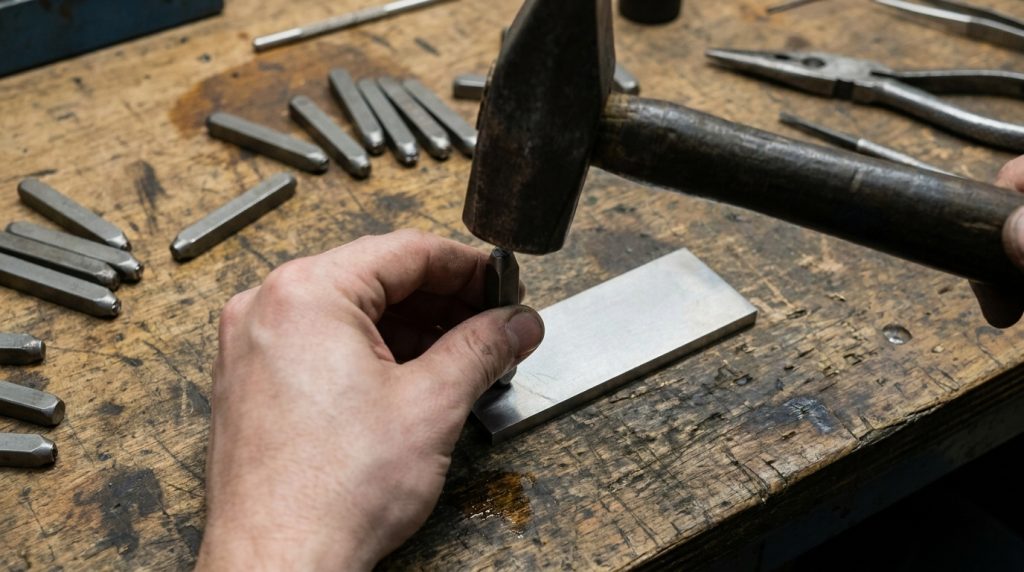
A stamp that leaves a crisp, legible mark on mild steel can leave a shallow, doubled, or torn impression on titanium using the exact same force and character geometry. The tool isn’t defective. The metal is doing exactly what titanium does under impact.
That surprise usually shows up the first time a shop moving into aerospace, medical, or defense work tries a standard stamp on a titanium part and the mark doesn’t hold up to inspection.
The Properties That Make Titanium Behave Differently Under Impact
Titanium alloys used in manufacturing, most commonly Ti-6Al-4V (Grade 5) and commercially pure Grade 2, share a set of mechanical properties that change how they respond to a stamped impression. Titanium’s elastic modulus runs roughly half that of steel, so the metal springs back more once the stamp lifts, closing up some of the depth just created. Published mechanical property data on Ti-6Al-4V shows the same combination of moderate elastic modulus and high hardness that makes the alloy predictable in aerospace design and unpredictable on a stamp bench set up for steel.
Titanium also work-hardens fast under localized impact. The first strike deforms the surface normally, but repeated or excessive force in the same spot hardens the material further instead of deepening the mark, which is close to the opposite of what happens with mild steel. Titanium’s thermal conductivity is also a fraction of steel’s, so the heat generated at the point of impact stays concentrated at the surface instead of dissipating through the part. That changes how the metal flows around the stamp face during the strike.
Three properties account for most of the trouble buyers report when a steel-spec stamp gets used on titanium:
- Low elastic modulus, which causes springback that shallows the mark after the stamp lifts
- Rapid work hardening, which resists a clean second strike in the same location
- Low thermal conductivity, which concentrates heat and changes how the metal flows at the impression
Each of these can be designed around. None of them get solved by pressing harder.
What Happens When a Steel-Spec Stamp Meets a Titanium Part
A stamp built to standard specifications for steel, meaning a hardness and character geometry tuned for mild or alloy steel, tends to produce one of three failure modes on titanium: an impression that reads shallow even at full striking force, doubled or blurred characters from the metal’s springback after impact, or visible galling on the stamp face as titanium’s tendency to adhere to tool steel under friction transfers material back onto the stamp.
None of these are marking method failures. They’re spec mismatches. A shop that switches to titanium parts without adjusting stamp material, character depth, and striking parameters is asking a tool built for one metal’s behavior to perform on a metal with a fundamentally different response to impact.
Why the Same Stamp Behaves Differently on Steel and Titanium
| Property | Mild Steel | Stainless 304 | Titanium (Ti-6Al-4V) |
|---|---|---|---|
| Relative hardness | Moderate | Higher than mild steel | High, and increases further with work hardening |
| Elastic springback | Low | Moderate | Significant |
| Thermal conductivity | Moderate | Low | Very low |
| Tendency to gall against tool steel | Low | Moderate | High |
The titanium column is where most steel-spec stamps run into trouble. Every difference in that row pushes toward a tool built specifically for the alloy, not a steel tool pressed harder.
Grade 2 and Grade 5 Titanium Don’t Mark the Same Way
Not every titanium part on a production floor is the same alloy, and that distinction matters for stamping. Commercially pure Grade 2 titanium is softer and more forgiving under impact, closer in behavior to a mild steel or aluminum marking job. Ti-6Al-4V (Grade 5), the alloy behind most aerospace structural and fastener applications, is harder, stronger, and more prone to the springback and work-hardening behavior described above.
A buyer specifying a stamp for Grade 2 titanium brackets and a buyer specifying a stamp for Grade 5 fasteners are effectively asking two different questions, even though both parts say “titanium” on the traveler. The alloy grade, not just the material family, is one of the first things a marking supplier needs to know. The same logic applies on the steel side, where grade selection changes stamp material and hardness in a comparable way.
Specifying a Stamp Built for Titanium, Not Adapted to It
A stamp built for titanium starts with a harder tool steel or carbide-faced construction to resist the galling that softer tool steels experience against titanium’s surface. Character geometry shifts too. Slightly deeper root angles and adjusted character spacing account for the metal’s springback, so the finished mark reads at the depth the spec actually requires, not the depth the stamp cut before the metal relaxed.
Striking method matters as well. A hand stamp asks an operator to deliver consistent force on a metal that punishes inconsistency more than steel does, which is one reason press-mounted or fixture-guided striking becomes more common once titanium volume increases. Buyers ordering a titanium-compatible stamp should be ready to specify:
- The exact titanium alloy and temper, such as Grade 2, Grade 5, or another designation
- The required mark depth after springback, not just at the moment of impact
- The production environment, whether that’s bench striking, press-mounted, or a high-volume line
- Any governing specification the mark has to satisfy, such as AS9100 traceability requirements or a customer-specific callout
Leaving any of these unspecified usually means a second round of tooling once the first stamp doesn’t hold up in production. Reading a spec sheet correctly matters even more on titanium jobs than on steel ones, since there’s less margin for a guessed dimension to work out.
Where Titanium Marking Requirements Show Up Most
Titanium’s strength-to-weight ratio keeps it in structural aerospace parts, airframe fasteners, and engine components, all of which require permanent identification that survives decades of service and full traceability audits. Medical device manufacturers use titanium for implants and surgical instruments, where identification marks have to meet depth and surface finish requirements without compromising the part’s biocompatibility. Defense and marine applications add titanium for the same corrosion-resistance and strength-to-weight reasons, with their own marking specifications layered on top.
Every one of those industries expects the identification mark to perform as reliably as the part itself. A shallow or doubled character isn’t a cosmetic issue on a traceable aerospace fastener or an implantable device. It’s a mark that can fail an inspection, and marking depth on a structural part carries engineering consequences beyond legibility.
How Devore Engraving Specs Stamps for Titanium Parts
Marking titanium correctly starts with the same question Devore asks about any material: what alloy, what depth, and what environment the stamp actually has to work in. For titanium specifically, that means building the stamp around the metal’s springback and work-hardening behavior instead of treating it as a harder version of steel.
- Custom machine and hand stamps built with tool steel and geometry suited to titanium alloys, not adapted from a steel spec
- Guidance on reading a titanium part’s alloy and temper into a workable stamp specification
- Full raw-steel-to-finished-tool capability in-house, so stamp material and hardness are matched to the application rather than sourced generically
A stamp that works on steel will not automatically work on titanium, and finding that out mid-production is an expensive way to learn it. The team at Devore Engraving can help you spec a stamp around the alloy you’re actually marking before it gets built. Request a quote and describe the titanium application you’re working with.]]>
