
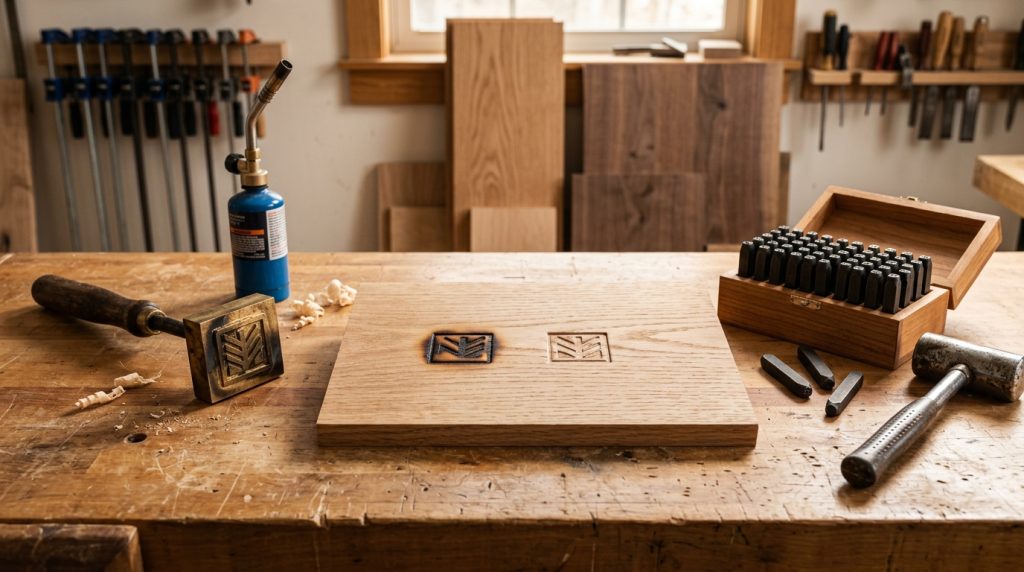
A branding iron and a steel hand stamp both leave a permanent mark on wood, and from across the shop they can look like two versions of the same tool. The real gap between them shows up in the order book, not the finished mark. One is built around a single recurring design. The other is built around flexibility, job by job.
For a small woodshop or furniture maker trying to decide between them, the right question isn’t which mark looks better. It’s which tool matches how often you’re marking the same thing versus marking something different every time.
Why This Comparison Isn’t About Durability
Devore has already covered how a branding iron style burn compares to a steel hand stamp impression on wood in terms of depth, contrast, and long-term wear. If that’s the question in front of you, that comparison covers it in detail. This piece starts from a different assumption: both tools can produce a mark that holds up for years. The real question is which one makes sense for your shop to own, given how you actually work.
What a Branding Iron Actually Costs a Small Shop
A wood branding iron is a single fixed design, usually a logo, name, or symbol, mounted on a head that gets heated before each use. Because the entire mark is custom-made as one unit, a branding iron typically carries a higher upfront tooling cost and a longer turnaround than a comparable hand stamp, since the full head has to be designed, cut, and finished before it’s usable at all.
There’s also an equipment layer beyond the iron itself. A branding iron needs a consistent heat source, whether that’s a propane torch setup or an electric branding system, which adds its own cost and bench space on top of the tool.
That investment makes sense when the mark itself doesn’t change. A furniture maker branding the same company logo onto every finished piece is buying one tool that gets used thousands of times without modification. The upfront cost gets spread across everything it ever marks, and the per-unit cost keeps dropping the longer it stays in service.
What a Steel Hand Stamp Actually Costs a Small Shop
A steel hand stamp set works differently. Individual character stamps, letters, numbers, or a custom logo stamp, are ordered as standalone tools that get combined by hand for each job. A shop can buy a standard alphanumeric set once and reuse those same characters indefinitely across completely different jobs: a customer’s initials one day, a commission number the next, a completion date after that.
That flexibility comes with a tradeoff. Assembling and aligning individual characters by hand takes more time per mark than pressing one fixed branding iron. For a shop stamping the exact same thing over and over, that per-mark time adds up fast. For a shop marking something different on nearly every job, it’s the entire point of owning the set.
The characters also outlast any single project. A set bought for furniture marking keeps working for shop tooling, jigs, or anything else that needs a permanent identifier later, which a single-purpose branding iron can’t do.
The volume question usually comes down to three things:
- How often the exact same mark gets applied without changing
- Whether the mark needs to vary from job to job (dates, initials, commission numbers)
- How much per-unit marking time the shop can absorb at its current order volume
Answer those three, and the tool choice mostly answers itself.
Order Volume Is the Real Decision Point
| Shop scenario | Branding iron | Steel hand stamp |
|---|---|---|
| Same mark on every piece, high volume | Cost per mark drops over time | Per-unit time cost adds up at volume |
| Mark changes job to job | Needs a new iron for each design | One character set covers unlimited variations |
| Low or occasional volume | Upfront cost is hard to justify | Lower entry cost, scales up as orders grow |
| Multiple elements in one mark (date, initials, model) | Needs a separate iron per element | Characters combine freely in one impression |
A shop running high volume on one fixed logo usually comes out ahead with a branding iron eventually, even with the higher upfront cost. A shop marking a mix of logos, dates, and job-specific codes gets more lasting use out of a flexible character set.
One-Off Custom Work vs Repeat Production Runs
Custom furniture makers and small production shops often run both situations in the same month. A signature logo gets applied to every piece that leaves the shop, while job-specific information, a customer name, a commission number, a completion date, needs to vary piece to piece. In that case, the two tools aren’t competing. They’re doing two different jobs on the same piece of furniture.
Shops that outgrow a hand-stamp-only setup usually get there gradually. The signature mark becomes consistent enough, and frequent enough, that converting it to a dedicated branding iron starts paying for itself, while the hand stamp set stays in service for everything else that still changes job to job.
How Devore Engraving Helps Woodshops Choose the Right Marking Tool
Devore builds custom hand stamps and character sets for shops that need marking flexibility, along with guidance on matching a stamp to different wood species and sizing a stamp correctly before it gets ordered.
- Custom hand stamp character sets sized and specified for your wood species and piece dimensions
- Guidance on which jobs justify a dedicated branding iron versus a flexible character set
- In-house raw-steel-to-finished-tool capability for custom logo and symbol stamps
Whether a branding iron or a hand stamp fits your shop comes down to what you’re marking and how often it repeats, not which tool looks more traditional. The team at Devore Engraving can help you figure out which setup actually matches your order volume. Request a quote and describe the marking jobs you run.
