
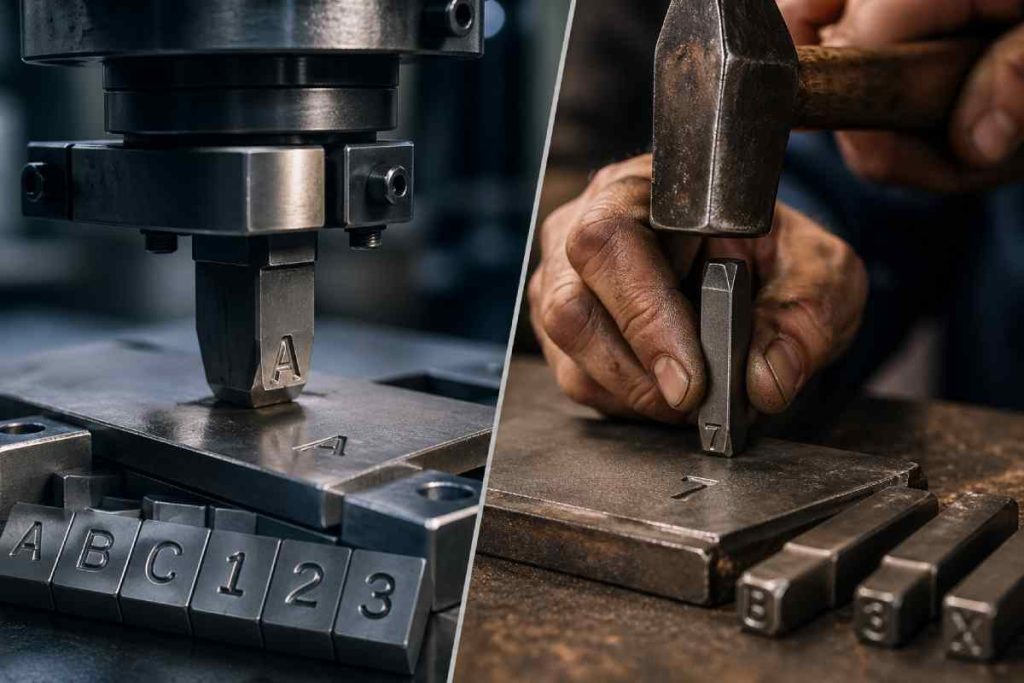
The decision between machine stamps and hand stamps is one of the most common specification questions in industrial marking. Both tools create permanent impressions. Both are manufactured from hardened steel. Both can carry numbers, letters, logos, and custom characters. But the conditions under which each performs best are very different, and choosing the wrong type leads to inconsistent marks, premature tool wear, and production slowdowns that compound over time.
This guide breaks down how each stamp type works, what separates them in practice, and how to match the right tool to your production environment.
What Machine Stamps Are and How They Work
Machine stamps are industrial marking tools designed to be mounted or held in a mechanical press, pneumatic system, or automated marking fixture. They are built to absorb repeated high-force impacts without deflecting or fracturing. The body geometry, shank dimensions, and face profile of a machine stamp are engineered for alignment stability inside a guided holder or press ram.
Because the force is applied mechanically rather than manually, machine stamps deliver consistent impression depth across every strike. The operator does not influence the result. The press does. This makes machine stamps the standard choice for any marking application where repeatability across hundreds or thousands of parts is a production requirement.
According to ASM International, tooling used in repetitive impact applications must be designed with consistent geometry and hardness specifications to maintain dimensional integrity under cyclical loading. Custom machine stamps built to these principles can sustain marking output through long production runs without degradation in mark quality.
Common machine stamp configurations include single-character stamps for use in holders, multi-character die sets, and full-line stamps for marking complete part numbers or serial strings in a single stroke. Custom metal machine stamps are typically ordered with precise shank diameters and lengths to fit existing equipment, which means dimensional accuracy during manufacturing is non-negotiable.
What Hand Stamps Are and How They Work
Hand stamps are held directly by the operator and driven into the marking surface using a hammer or mallet. The impression depth and angle depend on how the stamp is positioned and how much force is applied. There is more operator involvement in the result, which gives hand stamps a different profile of strengths and limitations compared to machine stamps.
What hand stamps offer is flexibility. They can reach surfaces that no press can access. They work on parts that are too large, too irregular, or too valuable to run through automated equipment. They require no fixturing, no setup time, and no tooling changeover. You position the stamp, strike it once, and the mark is done.
Custom hand stamps are manufactured from high-grade tool steel and heat treated for hardness, just like machine stamps. The difference is the body shape. Hand stamps have a longer, thicker grip body that allows the operator to hold and control the tool securely during impact. Face geometry, character size, and overall stamp length are all spec’d to suit the marking surface and the force being applied.
In low-volume marking environments, hand stamps are often the most practical and cost-effective solution. They are also widely used for secondary marking tasks in facilities that already use machine stamps for primary identification, covering rework marks, inspection codes, and field identification that falls outside the automated workflow.
Key Differences Between Machine Stamps and Hand Stamps
Understanding the practical differences helps clarify which tool belongs in a given production scenario. The comparison is not about which stamp is better overall. It is about which stamp is right for a specific combination of volume, surface access, consistency requirements, and operational setup.
| Factor | Machine Stamps | Hand Stamps |
|---|---|---|
| Force application | Mechanical or pneumatic press | Manual hammer or mallet |
| Mark consistency | High — press controls depth and alignment | Moderate — operator-dependent |
| Production volume | High-volume, repetitive runs | Low-volume or one-off marking |
| Setup requirements | Requires holder, fixture, or press integration | No setup — immediate use |
| Surface access | Flat or fixtured surfaces | Irregular, curved, or hard-to-reach surfaces |
| Portability | Fixed to equipment | Fully portable |
| Cost to implement | Higher initial investment (press/fixture required) | Low — stamp only |
| Operator skill required | Low once set up | Moderate — technique matters |
The table illustrates that neither stamp type dominates every category. Machine stamps win on consistency and throughput. Hand stamps win on flexibility and access. Many facilities use both, assigning each to the workflows it actually fits. The cost-to-implement gap is often the deciding factor for budget-conscious buyers — for a closer look at how that gap plays out financially, see our guide on calculating ROI for steel stamp investments.
When Machine Stamps Are the Right Choice
Machine stamps belong in production environments where marking is integrated into the manufacturing line. If parts move through a press, a forging operation, or an assembly fixture, machine stamps can be incorporated into the same process flow. Marking happens as part of production, not after it.
High-volume runs are the clearest use case. When the same identifier needs to appear on hundreds or thousands of parts with identical depth and positioning, machine stamps eliminate the variability that manual striking introduces. Quality requirements that specify mark depth tolerances, character legibility standards, or traceability consistency are difficult to meet reliably with hand stamping at scale.
Machine stamps are also the right choice when the marking must be placed in a precise location every time. Press integration allows for fixturing that controls exactly where the stamp contacts the part. There is no drift, no repositioning error, and no difference between the first part and the ten-thousandth part.
For operations that use small machine stamps in holder systems, the same consistency benefits apply at a smaller character scale. Small character marking for part numbers, inspection codes, and date stamps can all be handled within a guided holder without requiring a full industrial press setup.
When Hand Stamps Are the Right Choice
Hand stamps make sense when volume is low, when parts vary in shape or size, or when the marking location is not accessible with fixed equipment. These are not edge cases. A significant portion of industrial marking falls into one of these categories.
Maintenance environments, repair shops, and field service operations rely almost entirely on hand stamps. Parts being reworked or reinspected often need a secondary mark that confirms the action taken. There is no press available, no fixture, and often no flat surface to work with. A hand stamp is the only practical tool for the job.
Construction, mining, and railroad applications often require marking on large assemblies or structural components that cannot be brought to a press. The stamp comes to the part, not the other way around. Hand stamps are built to handle this. The grip body absorbs the hammer impact, and a well-designed stamp face transfers a clean impression even on slightly curved or textured surfaces.
Leatherworking and similar craft or specialty industries also favor hand stamps because the marking surface requires precise operator control over placement and pressure. Machine stamping would introduce too much force and too little finesse for those applications.
Review our custom steel stamps overview to see how stamp specifications align with common marking requirements across production and field environments.
Can a Facility Use Both?
Yes. Many do. The machine stamp handles primary identification on the production line. The hand stamp handles everything else. Secondary marks, rework coding, inspection stamps, field additions, and low-volume part batches are all practical hand stamp applications even in facilities that run machine stamps for their main marking workflow.
The two tools serve different roles within the same marking system. Treating them as alternatives when they can function as complements is a common planning mistake. A facility that only evaluates one option often ends up with the wrong tool for part of its marking workload.
The key is to map the marking tasks before selecting the stamp type. What surfaces need to be marked? What volumes are involved? What consistency standards apply? What is the access situation for each marking point? When those questions are answered clearly, the right tool for each task becomes obvious.
Choosing the Right Configuration for Either Type
Once the stamp type is selected, the next decisions involve face design, character size, body dimensions, steel grade, and heat treatment. These specifications determine whether the stamp performs as expected under actual production conditions.
Character size and mark depth must match the marking surface and readability requirements. Steel grade selection affects how the stamp holds up under repeated impact, especially when marking hard materials — see our guide to steel grades for custom stamps for a full breakdown of which alloys suit which applications. Heat treatment determines final hardness and wear resistance. These are not interchangeable decisions. Getting them right from the start avoids stamp failure, premature wear, and re-orders that disrupt production schedules.
Several factors to discuss with your stamp supplier before ordering include:
The material being marked and its hardness
The force method being used (hand, press, pneumatic)
Required character size and marking depth
Whether the stamp mounts into an existing holder or shank system
Volume expectations over the stamp’s service life
Any compliance or traceability specifications that govern mark legibility
Providing this information upfront allows the manufacturer to engineer the stamp correctly rather than supplying a standard configuration that may not perform under actual use conditions.
Devore Engraving Manufactures Both
Devore Engraving has produced custom machine stamps and hand stamps from its Canton, Ohio shop since 1963. Both product lines are manufactured entirely in-house, from raw steel through CNC machining, engraving, and heat treatment. There are no subcontractors involved, which means the specifications you provide are the specifications the finished stamp reflects.
Whether the application calls for:
High-volume machine stamps for press or automated integration
Portable hand stamps for field, maintenance, or low-volume use
Small machine stamps for holder-based character marking
Mixed configurations across different production tasks
The team at Devore can help match the right stamp type and specifications to the marking environment. If you have a marking application that needs the right tool selection, request a quote and get the details in front of their manufacturing team.
