
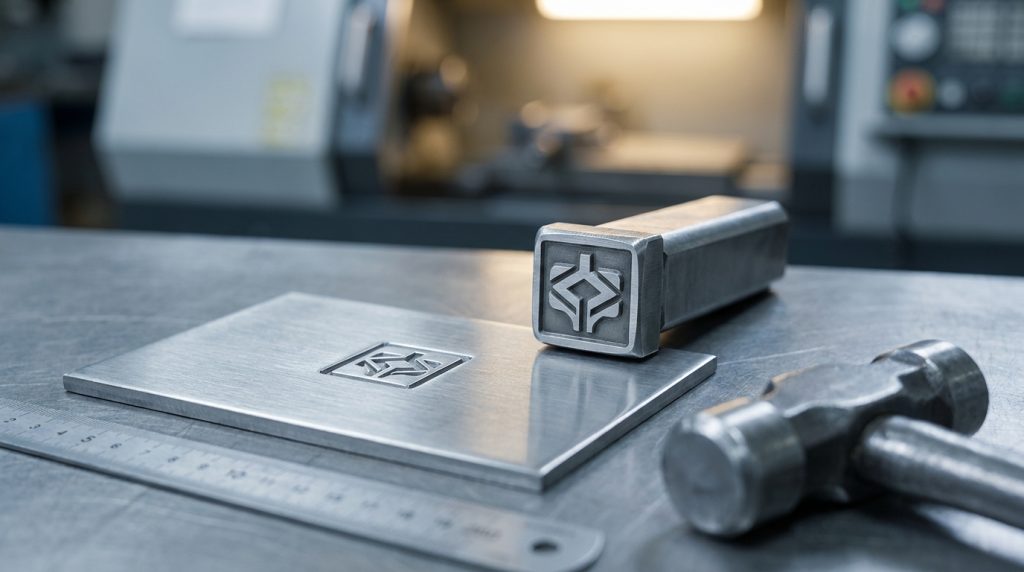
A CE mark on a printed label can peel, scuff, or wash off before a machine ever reaches an EU customer. The mark itself is not optional for products that need it, and the EU says how it has to look once it is on the product.
For makers of metal equipment, a stamped impression is one way to put the mark into the part instead of onto it. Here is what the EU asks of the mark, and what that means for the stamp or die that makes it.
What the EU Asks of the Mark Itself
The European Union’s business guidance states that the CE marking must be visible, legible, and indelible. It should preferably be affixed directly on the product. If that is not possible, it can go on the packaging or accompanying documents. The minimum size is 5 mm, unless the rules for a specific product say otherwise.
Responsibility sits with the manufacturer. That includes a company that has a product made and sells it under its own name or brand. Conformity assessment is a separate process, and Devore does not certify products or assess conformity. The scope here is only how the mark is physically applied.
The 5 mm figure is a default. Rules written for a specific product category can set a different size or add their own marking details. Which rules apply to a given machine is a question for the manufacturer’s compliance lead, and the stamp order should carry whatever size that answer produces.
Three physical requirements drive tooling choices:
- Visible: the mark sits where an inspector or customer can find it without disassembly
- Legible: the full CE graphic reads cleanly, with no missing or filled-in edges
- Indelible: the mark survives handling, cleaning, and service conditions
Each of these maps to a stamp specification, not just a mark design.
Why Metal Equipment Makers Turn to Stamped Impressions
A stamped impression is a deformation in the metal itself. It has no adhesive to fail and no ink to abrade. That is the reason shops that already mark serial numbers and part numbers by stamp often extend the same method to the CE mark.
| Requirement | Printed or adhesive label | Stamped impression in metal |
|---|---|---|
| Indelible | Depends on adhesive, ink, and exposure | Mark is part of the metal surface |
| Legible after service | Can scuff, fade, or lift | Holds with sufficient depth |
| Size control | Set by the printed artwork | Set by the engraved stamp face |
| Repeatability across units | Depends on the print process | Same tool, same impression |
A stamped mark is not the right answer for every product. Thin sheet, finished surfaces, and cast housings each behave differently under impact, which is why depth and material need attention before the stamp is ordered.
Choosing Where the Mark Goes on the Part
The EU guidance prefers the mark directly on the product. When that is not possible, packaging or accompanying documents are the stated fallback. A stamp only helps with the first option, so the location decision comes before the tooling decision.
For stamping, the best spot is a flat, accessible surface with enough thickness behind it to take the impression. Curved housings and tubes need a different approach, and roll dies are built for that case. If the plan is to stamp a plate that is then fixed to the machine, check the product rules to see whether that plate counts as marking the product itself. That is a compliance question the stamp supplier cannot answer for you.
The 5 mm Minimum Sets the Size of the Stamp Face
The stamp face is engraved at the size of the finished mark. If the product rules do not specify a different size, the CE graphic needs to meet the 5 mm minimum, and the artwork should follow the official reproduction guidelines. The European Commission publishes CE marking guidance, including how to reproduce the mark.
That makes the CE graphic a custom logo job. Redrawing it from a screenshot is how a stamp ends up with the wrong proportions. Supplying the official artwork and the target size on the order avoids a second round of tooling. Devore builds custom logo stamps from supplied artwork, and the first-time buyer’s spec guide lists the fields a stamp order needs.
Depth and Material Decide Whether the Mark Holds
Indelible in practice means the impression has enough depth to outlast the finishing steps. Painting, powder coating, and plating can soften a shallow mark, so depth is specified with the full production sequence in mind.
Depth has a cost on the other side. A deeper impression displaces more metal, which matters on thin plate and on load-bearing parts. Devore’s guide to marking depth and part strength covers that trade-off. Before ordering, a short test on the actual material shows how the stamp behaves, and the guide to testing whether a material can be hand stamped walks through it.
Hand Stamp or Machine Stamp for CE Marks
Volume decides this one. A shop marking a few units a week can strike a hand stamp against a fixture. A line that marks every unit does better with a machine-mounted stamp that delivers the same force and position each time. Consistency matters here because the 5 mm minimum and the legibility requirement apply to every unit that ships, not only the first.
Common mistakes on CE mark stamp orders include:
- Ordering the stamp from a redrawn logo instead of the official artwork
- Specifying a size below the minimum that applies to the product
- Choosing depth without checking the paint or coating step that follows
- Marking a finished, coated surface without testing the impression first
Most of these show up as a rejected unit or a retooled stamp, and all of them can be caught on the order form.
Checking the Mark Before the Unit Ships
The first impression off a new stamp is the one to inspect closely. Measure the graphic against the size on the order, look for filled or missing edges, and keep that impression as the reference for later units.
It also helps to record which stamp, material, and depth produced the approved mark. The EU does not require that record. It does make a retool or a replacement stamp much easier, because the next stamp can be specified from the same numbers.
How Devore Engraving Supports CE Mark Tooling for Exporters
Devore has built marking tools in Canton, Ohio since 1963, with design, CNC engraving, and heat treating handled in house. For exporters, that means one source for the stamp face, the hardness, and the holder.
- Custom logo stamps engraved from supplied CE artwork at the specified size
- Custom machine stamps for lines that mark every unit
- Depth and material guidance before the stamp is built, using a test on your part
A CE mark that fades or deforms is a problem that surfaces after the equipment has already shipped. Settling the size, depth, and artwork before the stamp is cut keeps the mark readable for the life of the product. Request a quote and send the artwork, the target size, and the material you are marking.
